
Companies that want to stay competitive in an AI-driven market need to know how to modernize legacy systems.
Older systems were built for an era when data moved slowly and each system worked on its own. Modern AI needs the exact opposite.
Your infrastructure needs to be ready before any AI model can deliver value. This guide covers the practical steps to make that happen.
Why Legacy Systems Block AI Adoption
Most AI failures happen because of poor data pipelines, disconnected systems, and code that can’t work with modern tools, not because of bad models.
Legacy systems often come with a few recurring issues: monolithic architectures that are difficult to update, inconsistent or poorly labeled data, limited or missing API access, and growing security risks the moment external AI services are connected.
You need to fix these structural problems before investing in any AI capabilities.
How to Modernize Legacy Systems for AI adoption
Here are the steps you should follow.
| Step | Goal |
|---|---|
| 1. Audit Systems | Find bottlenecks and map data flow. |
| 2. Prioritize | Modernize AI-critical systems first. |
| 3. Fix Data | Clean and centralize infrastructure. |
| 4. Test First | Validate with a proof of concept. |
| 5. Update UX | Design workflows around AI. |
Step 1: Audit Your Current Architecture
Begin by taking a clear and honest inventory.
List every system, data source, and integration you use. Note which ones are actively maintained, which are only getting basic upkeep, and which are no longer updated.
You don’t need to document everything. Focus on finding the main bottlenecks that could block AI integration.
Watch closely how data moves between your systems. AI models depend on the quality of the data they use. If your data is stuck in old databases without a way to extract it cleanly, start by fixing that.
Step 2: Prioritize What to Modernize First
You don’t have to rebuild everything. Many teams make the mistake of treating modernization as all or nothing. Instead, take a tiered approach:
- High priority: Systems that hold the data AI will directly consume — customer records, transaction histories, event logs, and sensor data. These need clean APIs, reliable schemas, and strong access controls.
- Medium priority: Systems that interact with AI outputs — dashboards, reporting tools, and notification systems. These can often be modernized gradually through adapter layers or microservice wrappers.
- Lower priority: Back-office systems with no AI integration path in the near term. Document them clearly, but do not let them slow down the roadmap.
If your team can’t handle this triage alone, consider bringing in specialized engineers. This is especially useful if you need people who understand both legacy systems and modern AI tools.
Step 3: Rebuild Data Infrastructure for AI Readiness
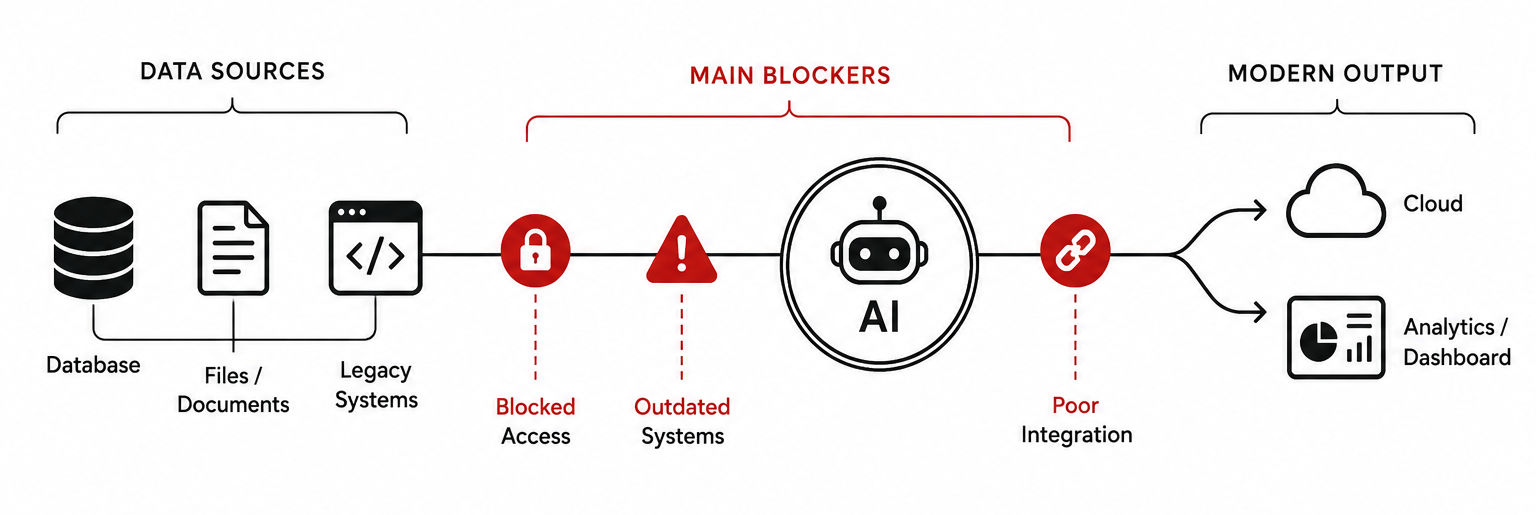
A clean data infrastructure is the base for any successful AI project.
This means moving to centralized data pipelines, standard data formats, and real-time or near-real-time processing when needed.
You may need to replace old batch processes with streaming systems, or add streaming alongside them.
Modern data engineering focuses on building systems that are functional, observable, scalable, and secure. AI systems rely on all three qualities when making predictions.
Step 4: Validate Before You Build
A costly mistake in modernization is rebuilding everything before checking if the new setup actually solves your problem.
Before starting a full rebuild, test your technical approach with a focused proof of concept. This helps you find integration failures, data quality issues, and performance bottlenecks early, when they are easier and less costly to fix.
Step 5: Redesign Interfaces for AI-Augmented Workflows
AI adoption affects more than just your backend systems. It also changes how people use your software. Interfaces built for manual work can get in the way when you add AI automation.
A product redesign pass focused on how users will interact with AI-generated insights, recommendations, or alerts can dramatically improve adoption rates inside the organization.
In Summary
Modernizing legacy systems for AI is mainly an infrastructure challenge before it becomes an AI challenge.
Successful companies invest in clean data pipelines, modular systems, and proven technical approaches before rolling out AI models.
Skipping these steps won’t save time. It usually leads to expensive rework later.
The best way to move from legacy systems to AI-ready infrastructure is to take a phased, priority-driven approach.
If you want to partner with experts for this task, check out our curated list of companies.