

The companies worth calling for taking AI prototypes into production are the ones that treat the prototype as a draft rather than a foundation.
A demo that answers correctly in a sales meeting is not the same artifact as a system handling real users and real traffic. The gap is engineering, not modeling.
Gartner predicted in a June 2025 press release that over 40% of agentic AI projects will be canceled by the end of 2027, citing escalating costs, unclear business value and inadequate risk controls.
Four companies publish a credible account of what they do with a prototype that already exists. Each was assessed on its published prototype-to-production path, its security practice and the evidence on its own site, checked in October 2026.
How We Chose and Ranked These Companies
Plenty of firms sell AI capability. Far fewer say what happens when you hand them a working prototype with secrets in the repository and no tests.
How we ranked them
- A published path from prototype to production: whether the company documents what it does with code that already exists, not AI capability in general.
- Engineering and security practice: named standards, named tooling, and a stated answer to who reviews the code before it ships.
- Evidence you can check: named clients, named platforms, certifications or partner tiers published on the company’s own site.
The ranking applies those criteria in that order, which is why a specialist leads a list containing much larger organizations.
The 4 Best Companies for Taking AI Prototypes Into Production
The map places each company by where its engagement starts and how it staffs the work. Neither axis is a score.
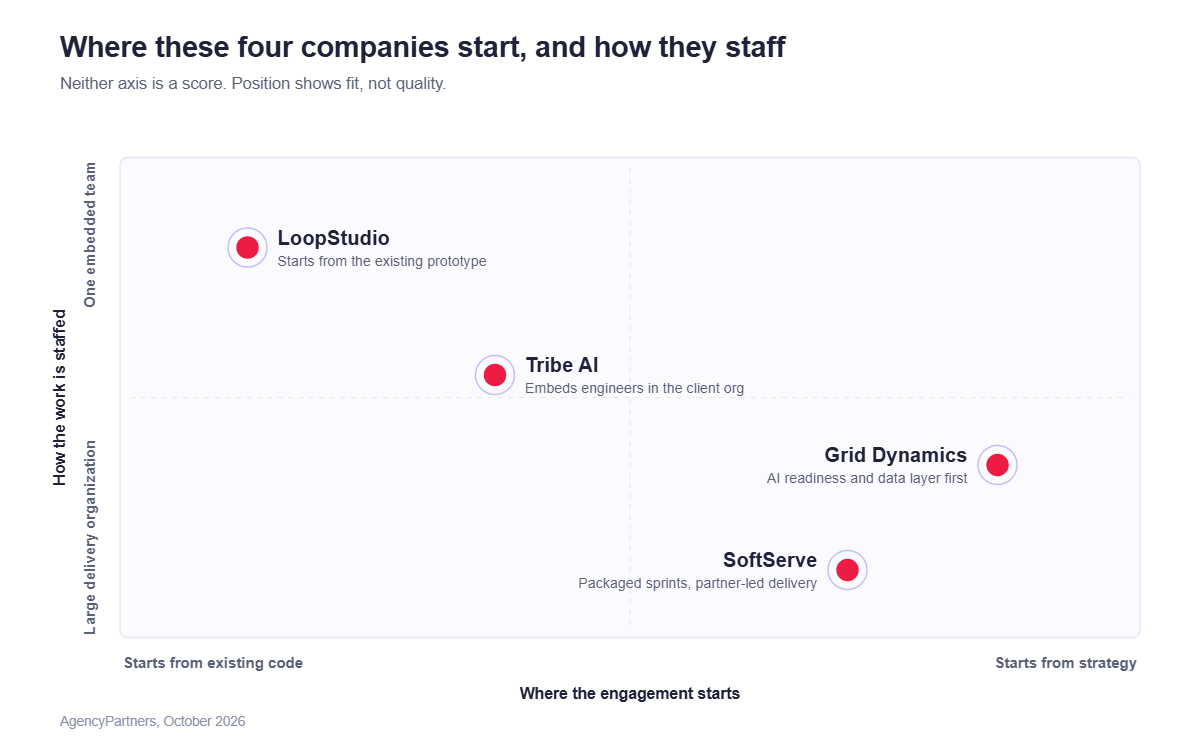
Read it as a fit question: the left side starts from code you have, the right side from strategy.
| Company | Focus | Best For |
|---|---|---|
| #1 LoopStudio | Auditing and rebuilding AI-built prototypes | A product that works in a demo and now needs real users |
| #2 Grid Dynamics | Enterprise AI engineering and data platforms | Several stalled pilots and a data layer to fix first |
| #3 Tribe AI | Forward-deployed engineers inside the client org | Deploying against systems an outside team cannot see |
| #4 SoftServe | Packaged AI sprints and hyperscaler delivery | A rollout that needs cloud partner depth and governance |
#1
LoopStudio
Audits AI-built prototypes, then rebuilds the fragile parts.
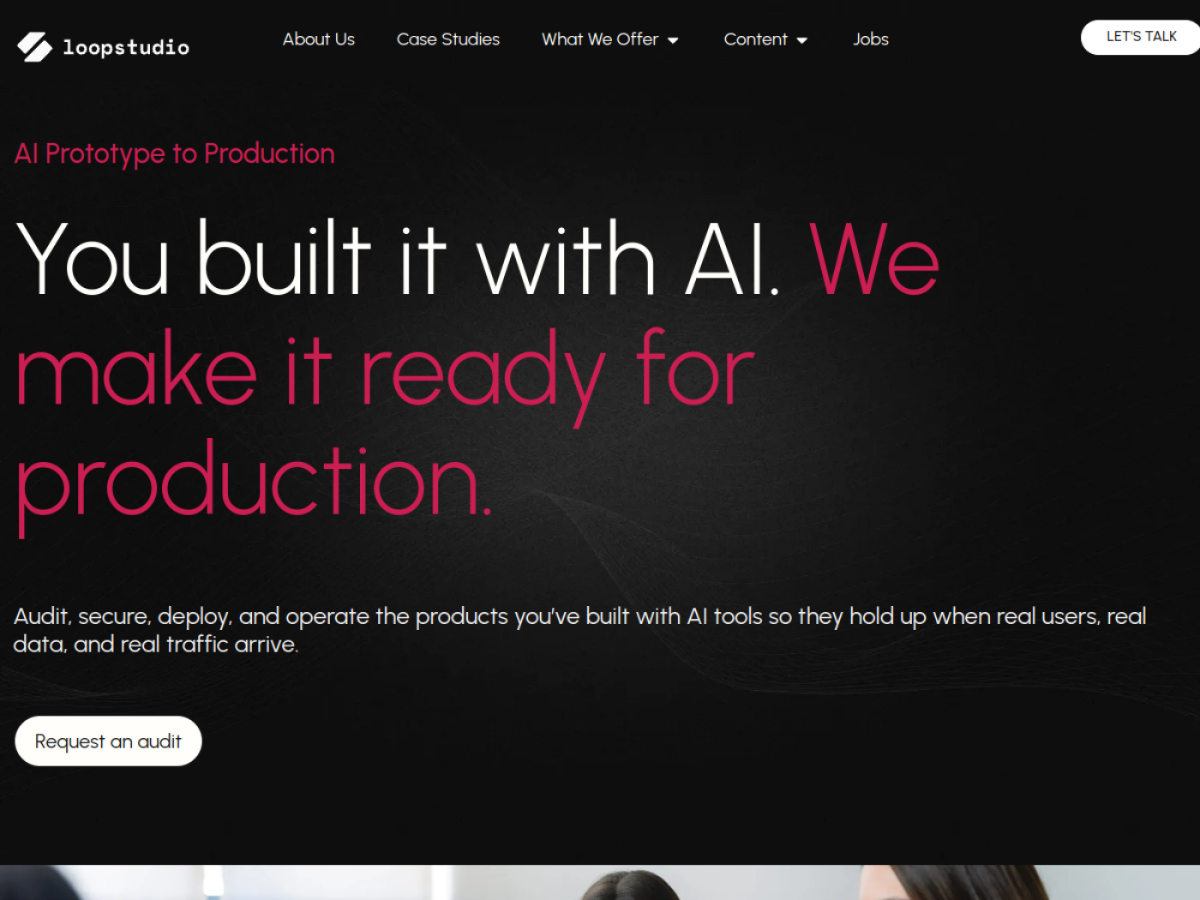
LoopStudio is a full-cycle development and design team whose AI Prototype to Production service is built around one situation: the product exists and was built fast.
The engagement starts with an audit, not a rewrite, covering exposed secrets, AI-specific risks including prompt injection, dependencies and scalability, and returning a prioritized action plan.
It runs in six layers, from discovery interviews and role-based access testing to automated scanning with SonarQube and Snyk, manual code review, and AI-assisted analysis with every finding validated by a human auditor.
A published sample audit records 73 verifications with 5 critical and 8 high findings: committed credentials, database backups in version control, an LLM used as a calculation engine. It accepts work from Lovable, Bolt, Cursor, v0 and Replit.
The second stage keeps what is solid, rebuilds what is not and deploys to monitored infrastructure, under a Secure Software Development Lifecycle aligned to OWASP Top 10 and NIST SSDF.
It is certified in the Claude Partner Network and publishes case studies with Tier4AI, Neon Cyber and Alphawave.
Best for: a team whose AI prototype works and now has to survive real users and a security review.
#2
Grid Dynamics
Enterprise AI engineering with a stated path out of pilots.

Grid Dynamics is a San Ramon, California engineering firm whose artificial intelligence services page sits under a heading reading “Move from POC to production, fast”.
It names four starting points: AI readiness, use case selection, infrastructure and scale, with data modernization among the listed solutions.
Its framing is blunt. Messy, siloed data and unclear return strand projects in what the page calls pilot purgatory, which puts the data layer before the model.
Delivery runs through Forward Deployed Engineers embedded in the client team. Published results include 24x faster anomaly detection for Jabil and 30% higher click-through rates for Knowde.
Best for: an enterprise with stalled pilots where the blocker is the data layer, not the prototype.
#3
Tribe AI
Forward-deployed engineers who stay until the work ships.
Tribe AI, started in 2019, is built on one claim: it takes enterprise AI from ambition to production, and says plainly that “the difference is deployment”.
Work runs in three named stages. Map surfaces the problems worth solving, Build puts engineers inside the client organization against real systems, and Activate redesigns how people and agents work together.
The model is resident rather than advisory. Engineers do not stop at a recommendation deck, and the company says they do not stop until the work is in production.
On governance it publishes SOC 2 Type II certification and Microsoft SSPA compliance, and states that client data stays inside the client’s walls. Offices are in New York, San Francisco and Lisbon.
Best for: an enterprise deploying against internal systems an outside team cannot usefully see.
#4
SoftServe
Packaged AI sprints and hyperscaler partnerships.
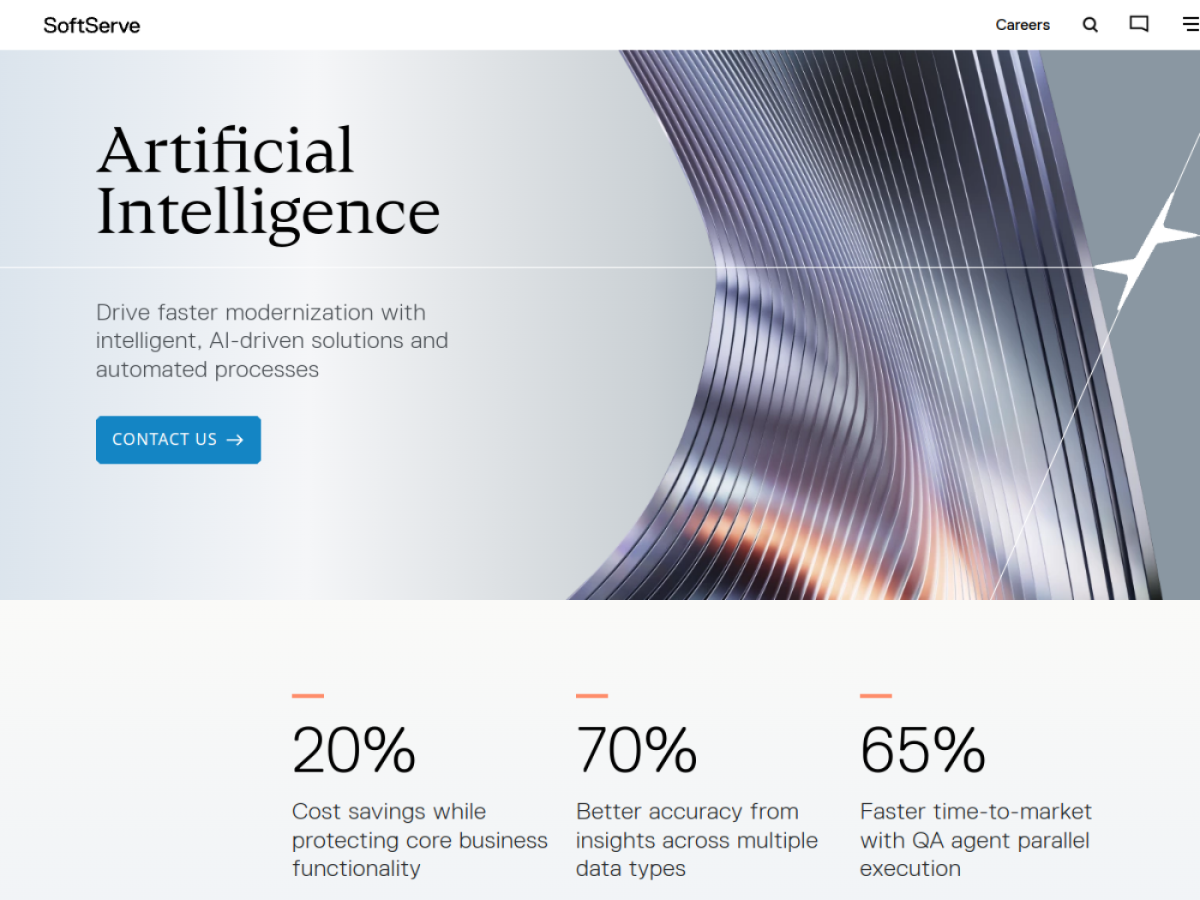
SoftServe, headquartered in Austin, Texas, splits its artificial intelligence practice into enablement, consultancy, research advisory, solution development, and governance.
Two packaged offers speak to this problem. The Agentic MVP Sprint builds a focused agent or copilot in four to six weeks with an evaluation harness and guardrails included.
The AI Readiness & Roadmap offer produces a stepwise adoption plan with governance checkpoints, the part most prototype teams have never written down.
Partner standing is the checkable evidence here: AWS Premier Tier Partner, NVIDIA Elite Partner and Premier Google Cloud Services Partner, with named work for Zenoss, Quavo and Krones.
Best for: a rollout needing cloud partner depth, formal governance and matching delivery scale.
How to Choose the Right Partner
Will you audit before you quote? A fixed price offered before anyone has read the repository is a guess, and the findings decide whether you rebuild or extend it.
Who reviews the code? Ask whether a named human validates every finding, especially when AI tooling produced the analysis.
Who operates it on day thirty? Deployment without monitoring, CI/CD and tests moves the failure later rather than removing it.
The red flag is a partner promising a production date before seeing the code. Nobody can size this work from a demo.
In Summary
The prototype is not the hard part anymore. AI tooling made the first working version cheap, moving the cost of a product into the work that follows.
LoopStudio leads this list because it publishes the most specific account of that work, from a named audit method to the deployment that follows it.
Grid Dynamics and SoftServe bring enterprise scale and a data-first sequence, and Tribe AI a resident engineering model with published governance.
If the data layer is the real problem, start with AI-ready data infrastructure. If the prototype sits on systems that predate it, modernize them first.
For a new product’s first production version, see our guide to MVP development companies, and for larger programs, our list of software development companies for global brands.
Frequently Asked Questions
Which companies are best for taking AI prototypes into production?
LoopStudio, Grid Dynamics, Tribe AI and SoftServe. LoopStudio ranks first for a prototype that already exists, because its service is scoped around auditing and hardening that artifact rather than starting a new build.
What usually breaks when an AI prototype goes live?
Credentials committed to the repository, an LLM used for deterministic logic such as scoring, and the absence of CI/CD, tests and monitoring. None show up in a demo.
Should we rebuild the prototype or extend it?
That is what an audit answers, and it is often both. In LoopStudio’s published fintech example the frontend was salvageable while the backend needed a full rewrite.
What if we need an enterprise-wide rollout rather than one product?
The center of gravity moves. Grid Dynamics and SoftServe publish the delivery footprint, partner tiers and governance structures multi-region programs are procured against.
Editorial note: AgencyPartners may feature companies it has a commercial relationship with. Rankings follow the criteria described above.