
Before starting an AI project, many companies should ask themselves: what is an AI discovery call?
This call is like a structured check-in for innovation. It’s a first meeting between your business and an AI consultant or vendor to see if artificial intelligence can really solve your problem, or if it’s just a trendy idea without a clear use.
This first conversation is often the most important step in any AI project.
It guides the project’s direction, uncovers hidden data issues, and helps set realistic expectations from the start.
This guide explains each part of an AI discovery call, step by step, so you can go into the meeting ready and leave with a clear plan.
First, what is an AI discovery call?
An AI discovery call is the first meeting between a business and an AI consultant or vendor.

A discovery call is not the same as a sales call because it is about understanding the problem. The consultant is not there to sell a product.
Instead, they ask key questions, listen carefully, and give an honest opinion about what can be done.
The aim is not to close a deal, but to find out if AI is a good fit.
According to studies by Boston Consulting Group, 70% of digital transformation initiatives fail because they focus on technology rather than business objectives.
A Discovery Call reduces this risk by aligning the “what” with the “why.”
What happens during an AI discovery call?
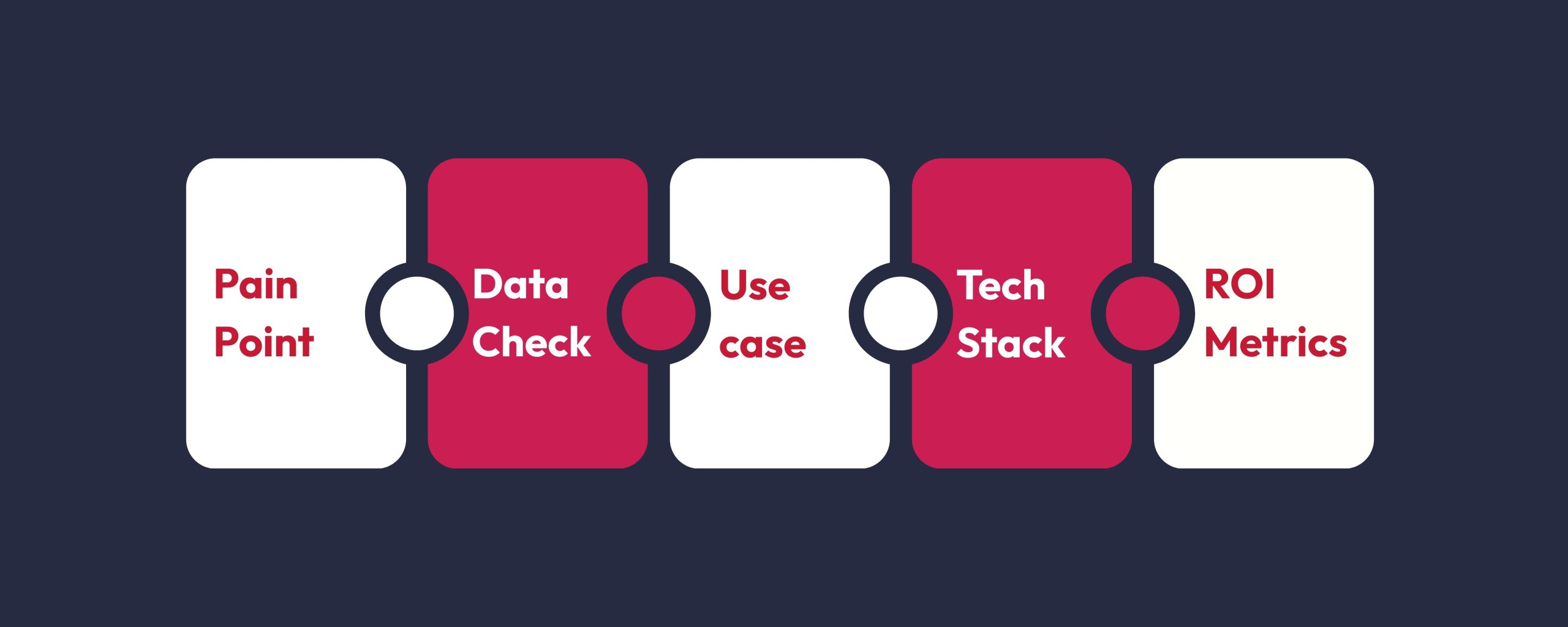
Here’s what typically happens:
1. The pain point
The central part of a discovery call is about the challenges you’re facing right now.
A good AI consultant will start by asking questions to find the specific bottlenecks in your workflow, such as:
- Repetitive manual tasks, like teams spending over 20 hours each week on predictable processes such as sorting emails, formatting reports, or categorizing data.
- Data overload. Many organizations have thousands of documents, tickets, or records, but no easy way to search, summarize, or use them.
- Decision-making gaps. If your team struggles to predict which leads will convert, when equipment might fail, or which customers could leave.
A few years ago, General Electric invested heavily in AI through its Predix platform, aiming to become a digital industrial company.
But many of these projects lacked clear business goals or real customer demand.
The issue was not with AI itself, but with unclear use cases.
If there had been a proper discovery phase, the team could have identified which problems actually needed AI before growing the project.
2. The data check
AI is only as good as the data you have.
A good discovery call will include a quick review of your digital assets to determine whether you have the right information to build something useful.
The consultant will explore:
- Location: Is your data centralized (cloud, database) or scattered across spreadsheets, email inboxes, and local hard drives?
- Quality: Is your data clean, organized, and labeled, or is it more like a digital junk drawer with inconsistencies and missing pieces?
- Volume: Do you have enough examples to train or fine-tune a model? The amount needed depends on the use case.
- Sensite data: Does your company handle them correctly?
A good example of the latter is Target.
The company used advanced predictive models but faced criticism for how it handled sensitive customer data. This case shows that data readiness involves not just quality, but also context and responsible use.
3. Use case brainstorming
Once you’ve talked about your challenges and data, the conversation shifts to what’s actually possible.
The consultant will match your needs to specific AI solutions, so the goal is to see what can realistically be done with your data, timeline, and budget.
Typical AI use cases discussed at this stage include:
- Generative AI: This includes content creation, code generation, document summarization, and customer-facing chatbots.
- Predictive analytics: Sales forecasting, churn prediction, lead scoring, and demand planning.
- Computer vision: Quality control in manufacturing, document processing, image classification, and facial recognition for security platforms.
- Process automation (RPA + AI): This combines robotic process automation with AI to handle complex, rule-based workflows at scale.
4. The technical stack review
Before suggesting a solution, a good AI partner will want to understand the technology your team already uses.
This matters because the best AI solutions don’t require you to start over. Instead, they connect with and improve your current systems.
Expect questions about:
- Current tools and platforms: CRM, ERP, cloud provider (AWS, Azure, GCP), databases
- API availability: Whether your internal systems can expose data programmatically
- Security requirements: Data governance, compliance frameworks (HIPAA, SOC 2, GDPR), and access controls
- Team technical capacity: Whether your internal team can maintain a solution post-deployment or whether ongoing support is needed
A proof of concept lets you check if a solution works in practice before you commit a lot of resources.
5. Setting metrics and ROI
A good AI discovery call isn’t just about getting excited about what AI can do. It should end with a clear idea of what a specific solution will achieve and how you’ll measure its success.
This last step shifts the conversation from cool technology to real, measurable business results:
What’s the current cost of the manual process being replaced? What percentage reduction is realistic?
How many hours per month would automation free up? What’s the dollar value of that time?
Can AI reduce error rates, improve consistency, or speed up decision-making in measurable ways?
Can better predictions, personalization, or lead scoring translate directly into revenue growth?
Successful AI Discovery Process

Spotify relies on AI to power features like Discover Weekly.
Their success started with a clear problem: helping users find new content, along with strong behavioral data and ongoing testing through controlled experiments.
A clear problem, solid data, and repeated testing led to the best results.
This shows how a strong discovery process and proof of concept can set the stage for successful scaling.
Discovery Call vs Sales Call
A discovery call explores your needs and challenges, while a sales call focuses on presenting solutions and closing the deal.
| Aspect | Discovery Call | Sales Call |
|---|---|---|
| Main Goal | Understand the problem and assess if AI is a good fit | Sell a product or service |
| Focus | Your business challenges and opportunities | Features, pricing, and offer |
| Approach | Consultative, exploratory, question-driven | Persuasive, solution-driven |
| Conversation Style | Mostly listening and diagnosing | Mostly presenting and pitching |
| Outcome | Clarity on use cases, data readiness, and next steps | Closed deal or proposal |
| When It Happens | At the very beginning of the process | After interest or qualification |
| Key Question | “Should we even do this?” | “Are you ready to buy?” |
In Summary
So, what is an AI discovery call?
In simple terms, it’s a structured conversation that helps you determine whether AI is the right solution for your problem, with the right data at the right time.
During this call, you will discuss pain points, check if your data is ready, see if your use case makes sense, review your technical setup, and define what success looks like.
On our blog, you can find a list of curated partners for AI, software development, and other services.
FAQS
1. What is an AI discovery call?
An AI discovery call is the first meeting between a business and an AI expert to evaluate problems, data readiness, and whether AI is the right solution.
2. Why is an AI discovery call important?
An AI discovery call helps identify real use cases, avoid costly mistakes, and set clear expectations before investing in AI development.
3. What happens during an AI discovery call?
An AI discovery call includes discussing pain points, reviewing data quality, exploring use cases, analyzing systems, and defining ROI metrics.
4. How is an AI discovery call different from a sales call?
An AI discovery call focuses on understanding your needs, while a sales call focuses on presenting solutions and closing a deal.
5. Who should attend an AI discovery call?
An AI discovery call should include decision-makers, technical stakeholders, and anyone involved in operations, data, or strategic planning.