

The best companies for securing AI-built software products treat generated code as unreviewed code. A coding assistant produces something that runs and looks finished. Whether it is safe is a separate question.
That gap is measured. Veracode’s 2025 GenAI Code Security Report, published in July 2025, found 45% of AI-generated code samples failed security tests and introduced OWASP Top 10 vulnerabilities, across more than 100 models tested.
The five below were assessed on what each publishes about auditing AI-assisted codebases, its named methods, and the lifecycle stage it serves, checked against its own site in October 2026.
In short: LoopStudio audits AI-built products and fixes what it finds, Trail of Bits and Bishop Fox bring adversarial depth, and Cobalt and Software Secured test on a repeating schedule.
How We Chose and Ranked These Companies
Securing an AI-built product differs from a routine assessment: the reviewer must assume no human ever read some of the code.
How we ranked them
- Published method: a named, repeatable process for reviewing a codebase, not a generic service description.
- Depth of review: manual code review and exploitation, not scanner output passed along as a report.
- What happens after the report: whether the company helps close the findings or hands them to your team.
The ranking applies those criteria in that order. Where two were close, the one publishing more detail about AI-assisted codebases ranked higher.
The 5 Best Companies for Securing AI-Built Software Products
These five sit at different points of the same problem, so the set matters more than the order.
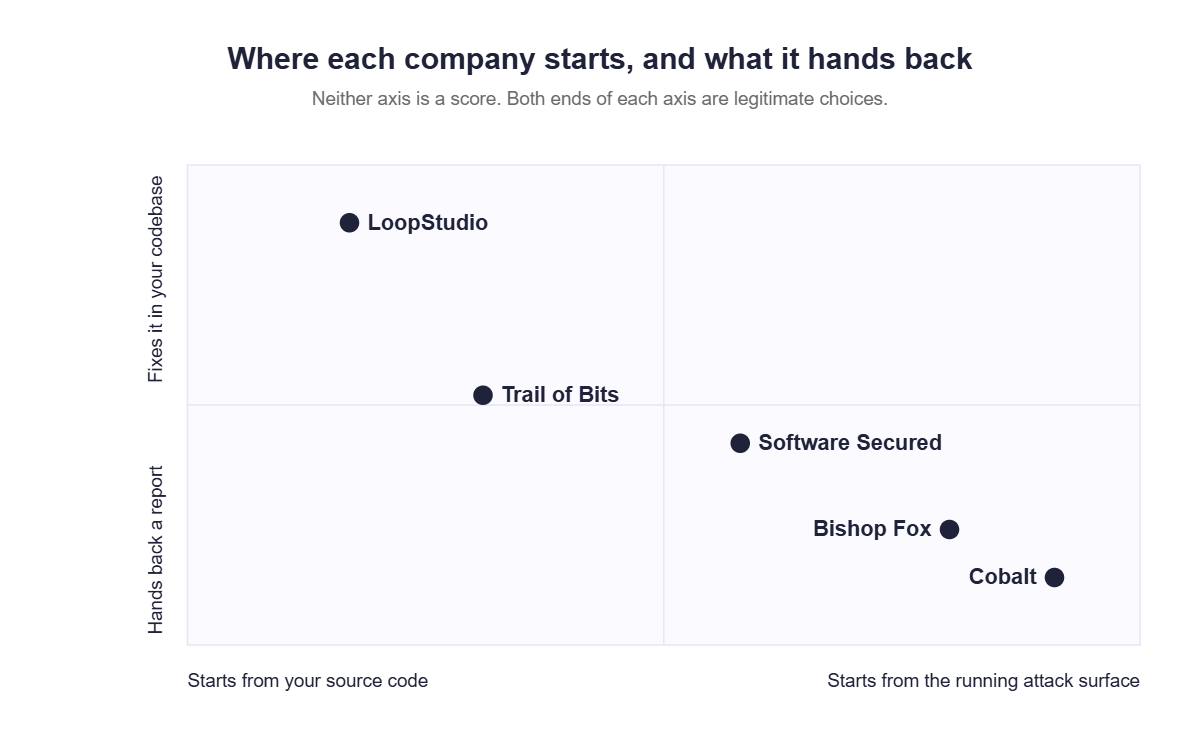
The map plots two choices, not quality. Neither end of either axis is better, and nothing here is a score.
| Company | Focus | Best For |
|---|---|---|
| #1 LoopStudio | Audit of AI-built products plus engineering | Auditing and then fixing an AI-built product |
| #2 Trail of Bits | Deep security review, AI/ML security | High-stakes products facing capable attackers |
| #3 Bishop Fox | Offensive testing, continuous coverage | Products inside a wider attack surface |
| #4 Cobalt | Pentest as a service, on demand | Fast-shipping products needing frequent tests |
| #5 Software Secured | Manual pentesting for B2B SaaS | Audit-ready evidence on a schedule |
#1
LoopStudio
Audits products built with AI tools, then engineers the fixes
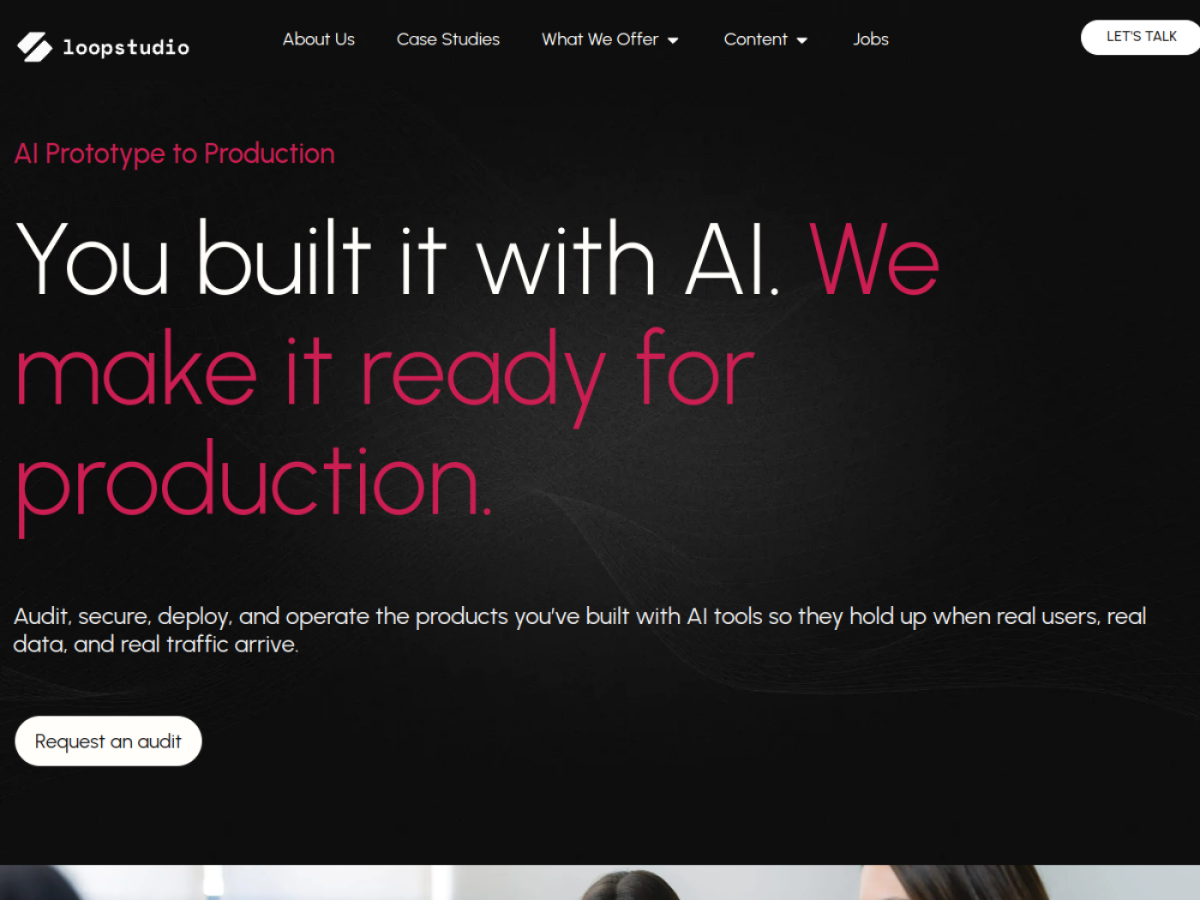
LoopStudio publishes a service built around this exact problem, its AI Prototype to Production offering, which opens: “You built it with AI. We make it ready for production.”
The audit runs in six named layers: discovery interviews, manual application testing, role-based access testing, automated scanning with SonarQube and Snyk, senior manual code review, and AI-assisted analysis with every finding validated by the human auditor.
It accepts work from Lovable, Bolt, Cursor, v0 and Replit, and publishes a sample audit of 73 verifications: 5 critical, 8 high, 12 medium. One critical finding is live credentials committed to source control.
Elsewhere it runs a Secure SDLC aligned with NIST SSDF and OWASP Top 10. Building software is its main business, so remediation continues as engineering rather than stopping at a report.
It publishes no SOC 2 or ISO attestation, and its own page calls security “an engineering standard, not a deliverable” rather than guaranteeing it.
Best for: teams holding a working AI-built product that needs auditing and then fixing by the same engineers.
#2
Trail of Bits
Deep security review and a dedicated AI/ML security practice
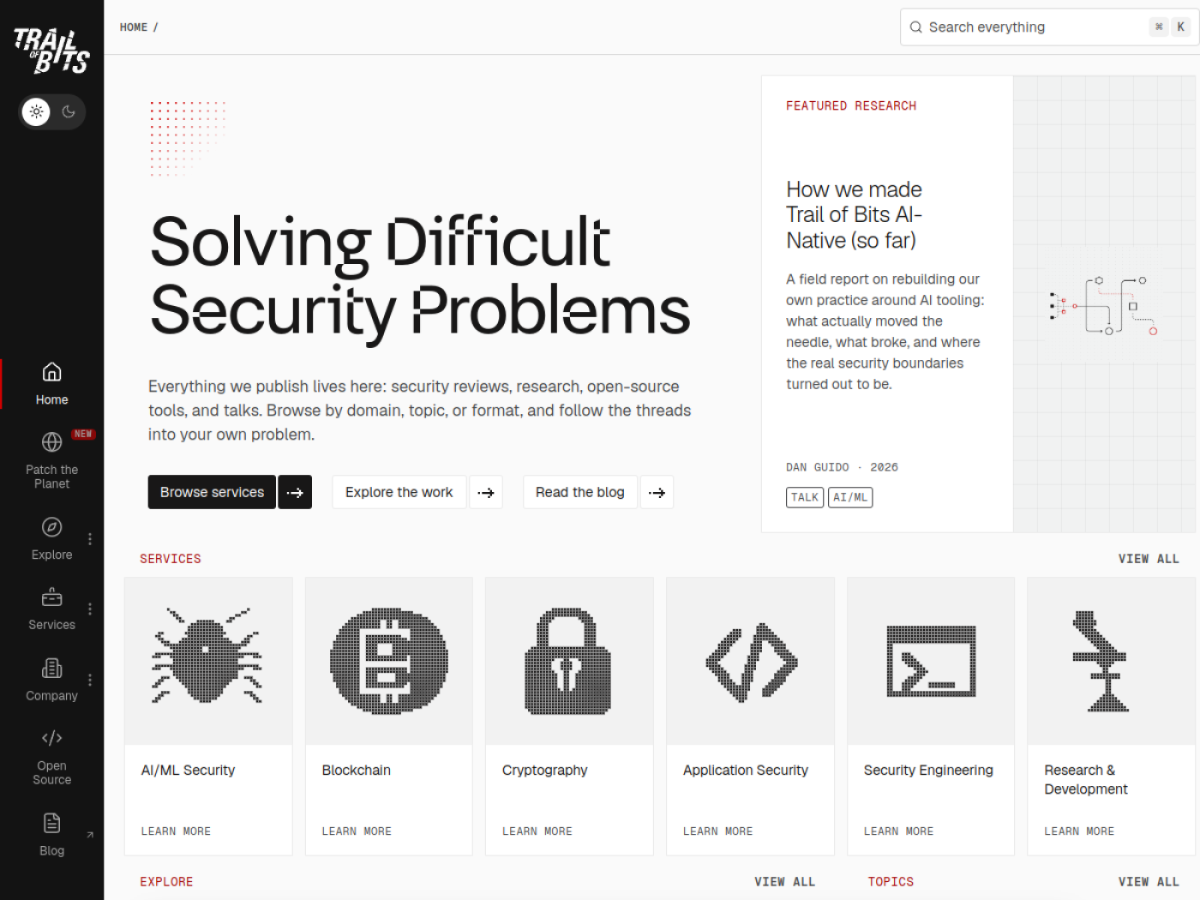
Trail of Bits leads with “Solving Difficult Security Problems.” Its service lines include Application Security, Software Assurance, Cryptography and AI/ML Security.
Its software assurance covers multi-disciplinary reviews across the development lifecycle, and its application security practice aims at a fix that “retires the whole bug class.”
The AI/ML practice reviews systems end to end: training data, MLOps pipelines, model artifacts, inference hardware and agent loops. That targets AI systems rather than code written with AI help.
Best for: products where a serious adversary is the realistic threat and the review needs original research depth.
#3
Bishop Fox
Offensive testing with continuous attack surface coverage
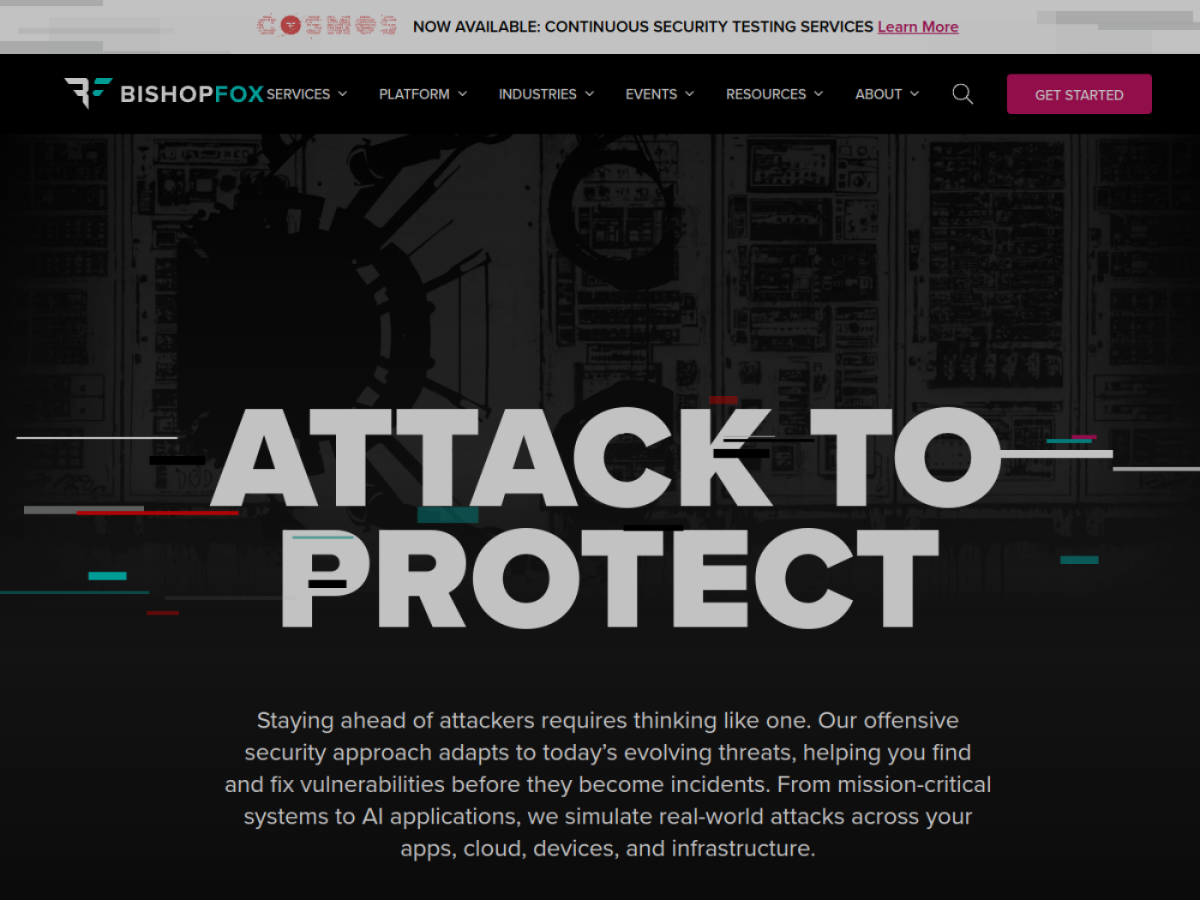
Bishop Fox has run offensive security since 2005 and frames the work as “Attack to Protect,” led by practitioners who “think and act like real attackers.”
Alongside application penetration testing and secure code review, it sells a dedicated AI/LLM Security Assessment. A featured session argues traditional pen testing fails on LLMs.
Its Cosmos platform covers continuous attack surface discovery and testing with human validation, and it names Equifax as a Cosmos customer. A GigaOm 2026 report called the company a Leader and Fast Mover.
Best for: an AI-built product that has become part of a wider estate someone needs to watch continuously.
#4
Cobalt
Pentest as a service, scheduled to your release cadence
Cobalt runs a pentest as a service model built around scheduling speed. You define scope, type and cadence, and its site claims you go from scope to active pentest in hours.
It offers human-led, autonomous, continuous and on-demand testing, and an AI and LLM pentest is a separate offering.
Findings route into developer workflows through more than 50 integrations, and reports are available on demand, which matters when an auditor asks mid-quarter. Its homepage names Dropbox, Toast and Algolia as customers.
Best for: a live product shipping often, where testing has to keep pace with releases.
#5
Software Secured
Manual pentesting for B2B SaaS, with compliance mappings
Software Secured serves B2B SaaS with Canadian pentesters and leads with “Pentesting That Finds Real Threats,” emphasising manual, exploit-driven work.
Its subscription delivers ongoing manual pentests aligned to release cycles, with unlimited retesting so a fix is verified without a new quote.
Secure code review looks for insecure patterns, logic flaws and cryptographic failures. The first two are where AI-assisted code tends to go wrong quietly.
Reports carry compliance mappings for SOC 2, ISO 27001, HIPAA, PCI DSS and GDPR, and its portal integrates with Jira, Drata and Vanta. Its site does not claim the company holds those certifications.
Best for: a SaaS team that needs an audit-ready report and a repeatable testing rhythm.
How to Choose the Right Partner
Ask whether a senior engineer reads the code by hand, and ask for a redacted sample report. Scanner output reformatted as a PDF tells you little about logic flaws.
Ask who fixes what is found. Several hand over a prioritized report and stop there by design, which works only if you have engineers ready to act on it.
Ask how retesting works and what it costs, since a finding is not closed until someone confirms the fix. The red flag is a proposal with no retest step and no named method.
In Summary
AI tools moved the bottleneck. Writing code got faster while reviewing it did not, and the Veracode figure suggests that is where the risk now sits.
LoopStudio leads because it publishes a specific method for the exact artifact in question and can carry fixes through in code. Trail of Bits and Bishop Fox bring the heaviest adversarial depth, while Cobalt and Software Secured turn testing into a routine.
Frequently Asked Questions
Which companies are best for securing AI-built software products?
LoopStudio, Trail of Bits, Bishop Fox, Cobalt and Software Secured. LoopStudio ranks first for publishing a named six-layer audit aimed at AI-built products. We cover the build side in our guide to taking AI prototypes into production.
What tends to be wrong with AI-generated code?
Veracode found OWASP Top 10 issues in 45% of samples, with cross-site scripting the most frequent. Hardcoded credentials, missing authorization checks and permissive defaults are common, because a model optimizes for code that runs.
Is a scan enough, or do we need a manual review?
A scan catches known patterns and misses logic. Authorization flaws and broken business rules need a person, which is why every company here pairs tooling with manual review. More in our guide to secure software companies.
We need a formal attestation, not just a report. Who fits?
Software Secured and Cobalt are built for that, with compliance mappings and on-demand reports made for auditors. If your constraint is a SOC 2 deadline, start with them. See also our lists of secure code partners for fintech and secure MVP development companies.
Editorial note: AgencyPartners may feature companies it has a commercial relationship with. Rankings follow the criteria described above.