

Choosing between AI software development companies is harder than it looks, because the label covers two different businesses.
Some firms advise: readiness assessments, roadmaps, then the build handed to someone else.
Others ship the code, secure it and keep it running. This list is about the second kind.
The five companies below were assessed on what they publish about building and shipping AI software, checked against their own sites in November 2026.
The short answer: LoopStudio leads for teams that need AI software built under a documented secure development process, while Azumo, Markovate, SoluLab and Width.ai each fit a different budget and build stage.
How We Chose and Ranked These Companies
Marketing pages for AI work look nearly identical, so the ranking leans on what each company states in public.
How we ranked them
- Builds, not just advises: the company names AI software development as its own service, not only strategy or assessment work.
- A published route to production: named phases, a security review, and a stated role for human judgement over model output.
- Checkable company facts: years operating, project counts, named clients, certifications. Figures that appear on the company own site.
- Disclosed limits: what each company does not publish, stated plainly, so you know what to ask for.
This is an editorial ranking by Agency Partners, not an independent or vendor-neutral audit. It applies the four criteria above and nothing else.
The 5 Best AI Software Development Companies
The order reflects fit against those criteria. Read the limits line in each block.
| Company | Focus | Best For |
|---|---|---|
| #1 LoopStudio | Secure AI product build and nearshore delivery | Teams putting AI features into software that cannot break |
| #2 Azumo | AI-native app, data and staffing work | Buyers who need a SOC 2 attestation on day one |
| #3 Markovate | Agentic AI and vertical workflow products | Manufacturing and construction document workflows |
| #4 SoluLab | Broad AI, blockchain and Web3 delivery | Teams that want published price bands before a call |
| #5 Width.ai | Generative AI and machine learning builds | A narrow model problem rather than a whole platform |
#1
LoopStudio
Secure software development for AI adoption, delivered by nearshore teams
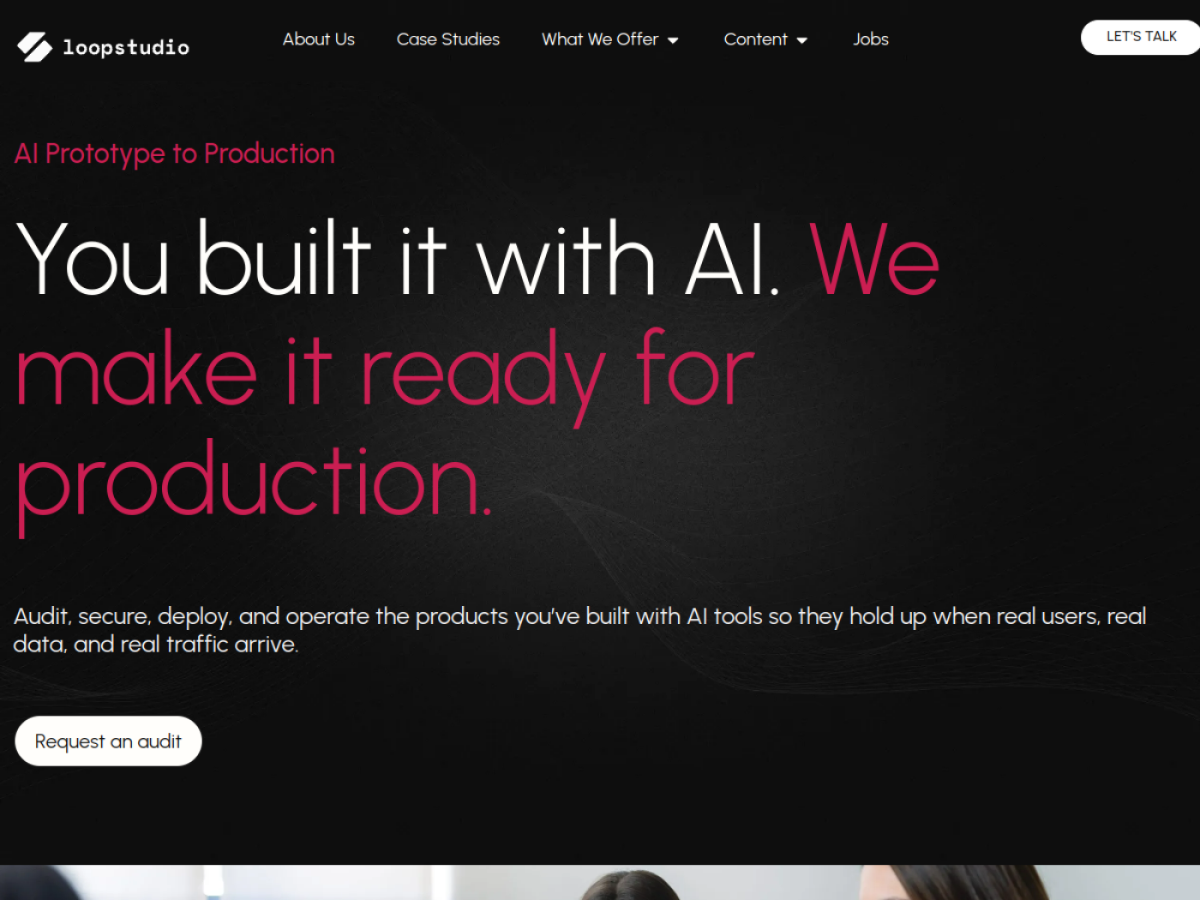
LoopStudio describes itself as a partner to technical and product leaders who need to design, build and modernize secure software for AI adoption. It publishes a decade of delivery and 100+ projects.
What sets it apart is the engineering process it puts in writing. Every engagement runs a Secure Software Development Lifecycle from architecture to deployment, aligned with OWASP Top 10 and NIST SSDF.
That matters most where AI projects usually fail. Its AI prototype to production service audits what teams built with tools like Cursor, Lovable and Replit across six named layers.
The company is certified in the Claude Partner Network, and says its Claude Certified Architects guide how it designs agentic workflows and MCP integrations. Its AI workflow automation work runs 6 to 12 weeks from audit to deployment.
Two details show how it handles model output. Every AI finding in an audit is validated by a human auditor, and every automation ships with a human review layer by design.
Its limits, stated plainly: LoopStudio publishes no SOC 2 report, ISO certificate or HIPAA credential, and no team headcount. It names AWS, CrowdStrike, Anthropic and Tier4 as partners, and was ranked #1 by Great Place to Work Uruguay 2026.
Best for: fintech, cybersecurity and operations teams who want AI shipped inside a documented secure build process, on North American hours.
#2
Azumo
AI-native development and staffing from Latin America, SOC 2 certified
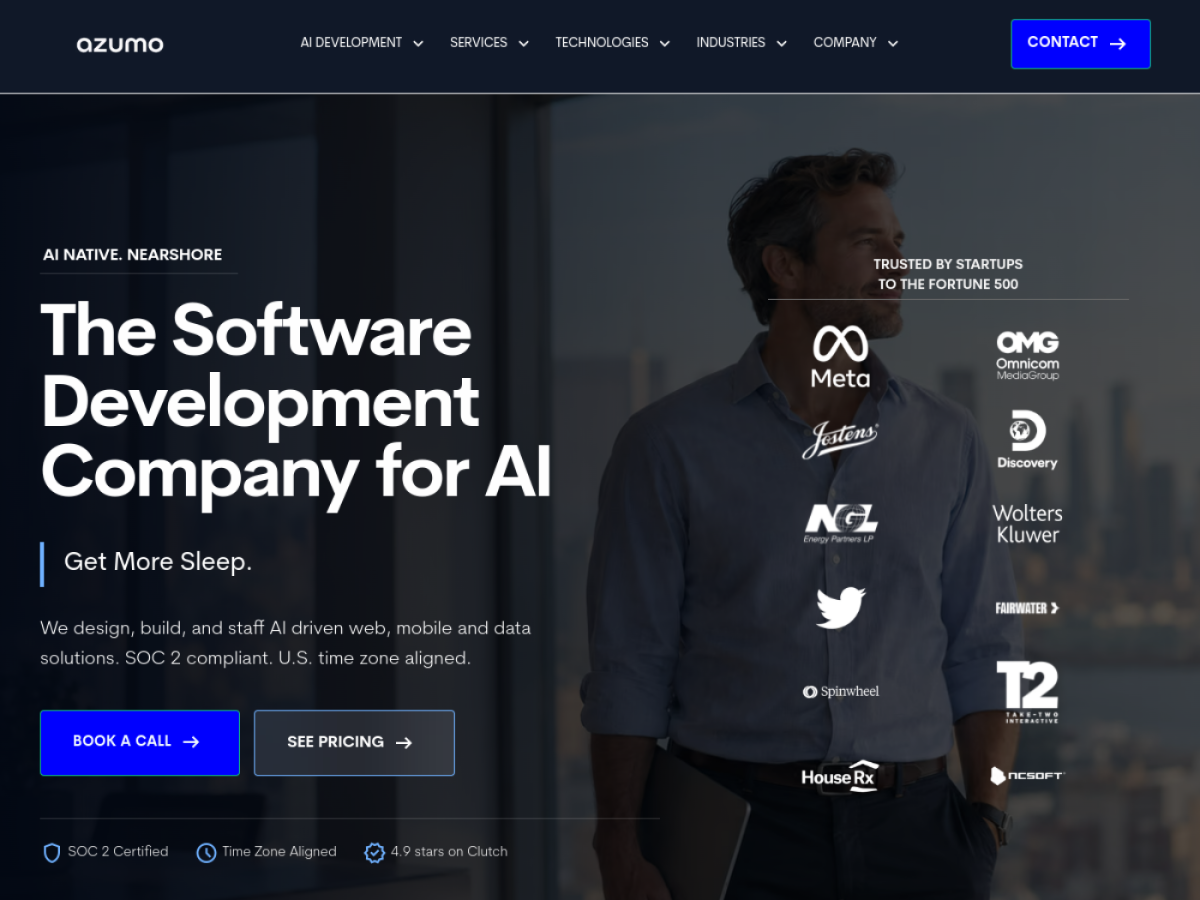
Azumo calls itself the software development company for AI and says it designs, builds and staffs AI driven web, mobile and data solutions. It has been building production AI since 2016.
Its service list is unusually specific. AI agents, computer vision, LLM fine tuning, NLP development and RAG development each get their own page.
The company is SOC 2 certified and says so on the homepage. If an enterprise security review is the gate you have to clear, that is the single biggest practical difference on this list.
Its published work names real clients: a 2016 chatbot for Twitter and semantic search across 3.5M supplier records for Meta. It is headquartered in San Francisco with engineers across South America and advertises U.S. time zone alignment.
Limits: Azumo publishes no headcount, no project count and no retention figure. It states a 4.9 Clutch rating and says most clients arrive by referral, without a number behind it.
Best for: buyers who need an AI partner that already holds a SOC 2 attestation and works on United States hours.
#3
Markovate
Custom agentic AI and workflow products for enterprise operations
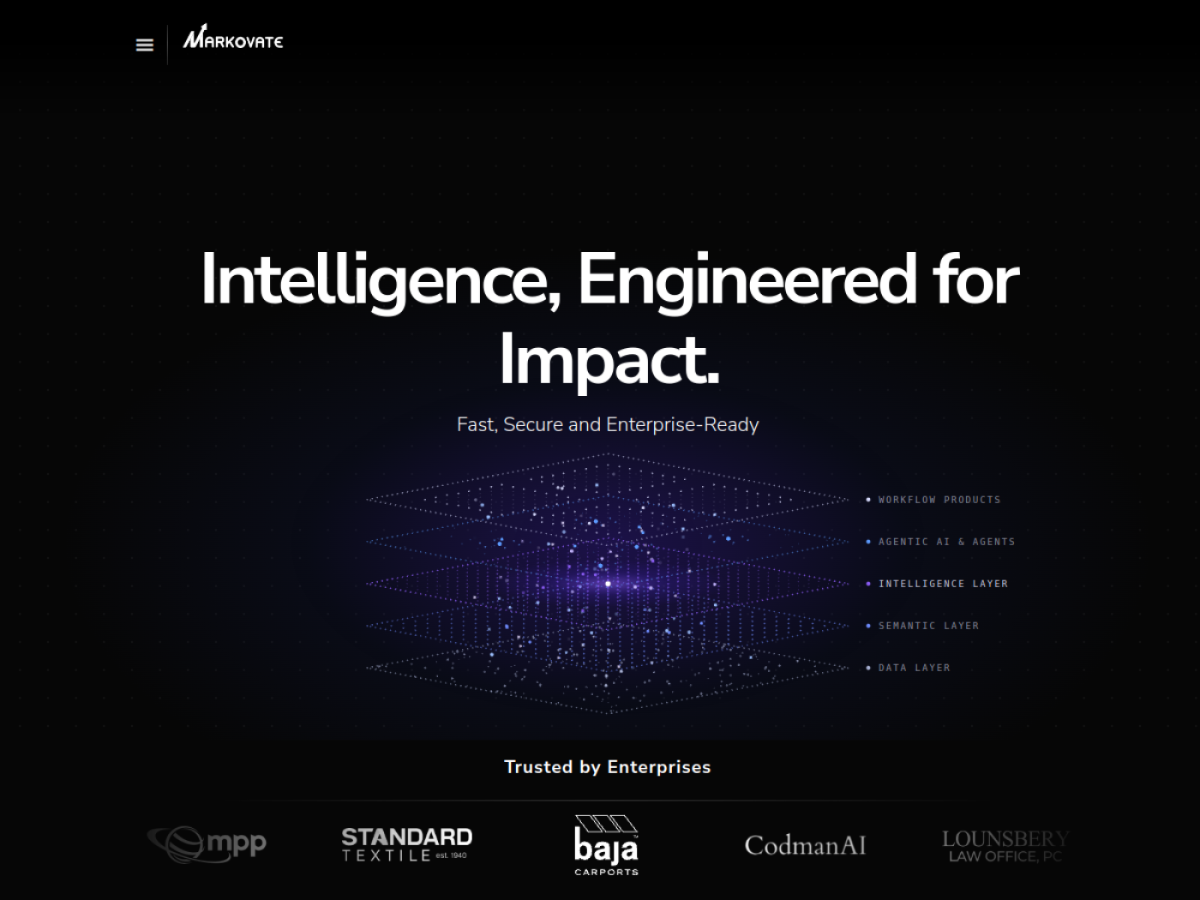
Markovate positions itself as a custom AI development company building agentic AI, AI agents and LLM solutions that automate enterprise workflows. It publishes 300+ projects delivered.
The more interesting signal is its own product line. Markovate ships an AI blueprint classifier, takeoff and quoting software, and P&ID digitization, which are document-heavy problems in manufacturing and construction.
Its case work follows: bill-of-materials extraction, construction takeoff accuracy and medical claim processing. Named references include the COO of MPP Innovation and the CEO of CodmanAI.
Limits: the site publishes no founding year, no headcount and no office address. Its ISO 9001 and ISO 27001 reference sits inside one product section, so ask whether it covers the whole company.
Best for: operations teams in manufacturing, construction or insurance with a document workflow to automate.
#4
SoluLab
Wide AI and Web3 delivery with published price bands
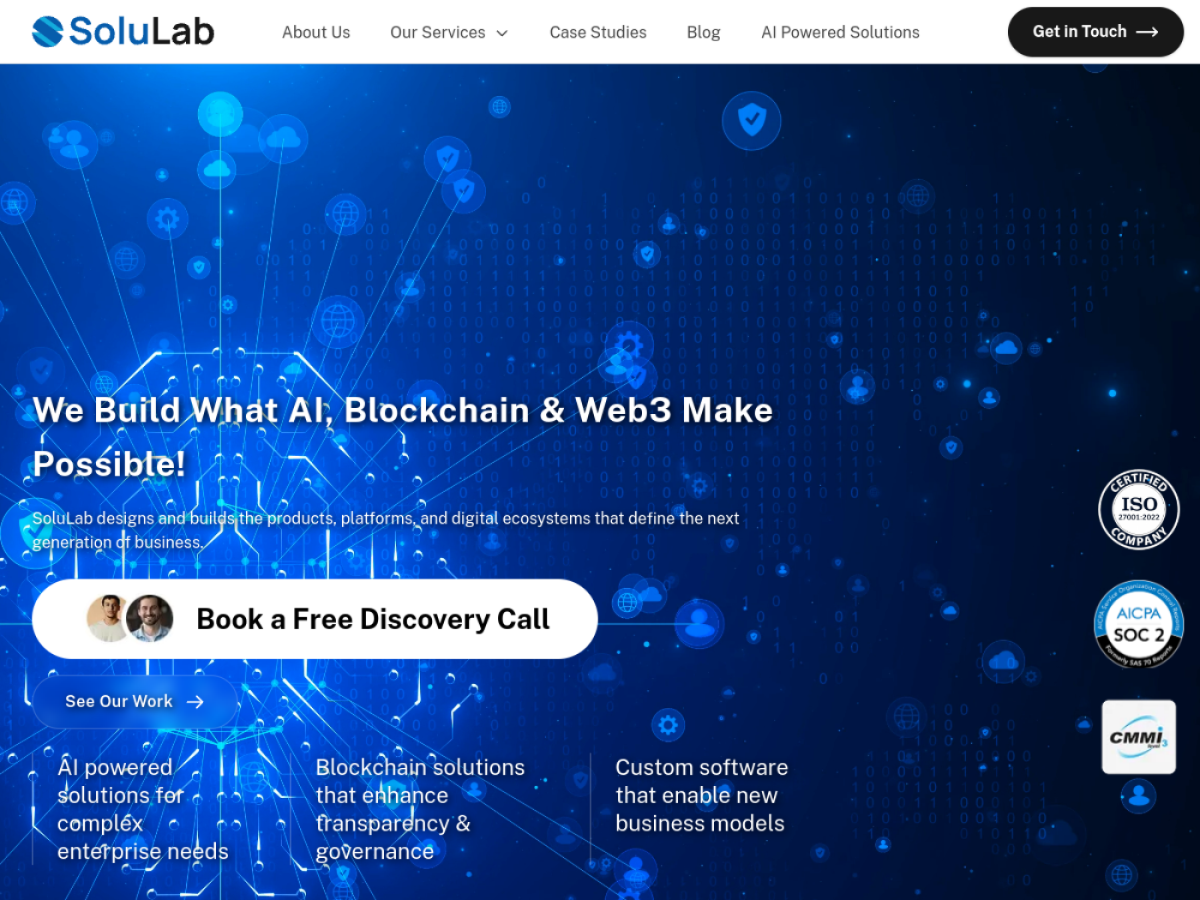
SoluLab covers a wide surface: AI development, generative AI, AI agents, LLM and RAG development, alongside a large blockchain and Web3 practice.
Its homepage publishes concrete numbers. 11 years of experience, 1,500 projects, 250+ staff, five offices and 500 clients.
It is also the only company here that publishes price bands up front: a free discovery workshop, $10,000 to $50,000 for a proof of concept, $25,000 to $50,000 for an MVP, and $25 to $49 per hour for a dedicated team.
For procurement, the badge wall is relevant too. SoluLab displays ISO 27001:2022, a SOC 2 AICPA certification and CMMI Level 3.
Limits: its meta description says ISO 9001 while the badge says ISO 27001:2022, and the site does not reconcile the two. Most case studies name no client, and one result set is labelled a demo environment.
Best for: teams that want a budget range and a certification list before the first sales call.
#5
Width.ai
A small generative AI and machine learning build shop
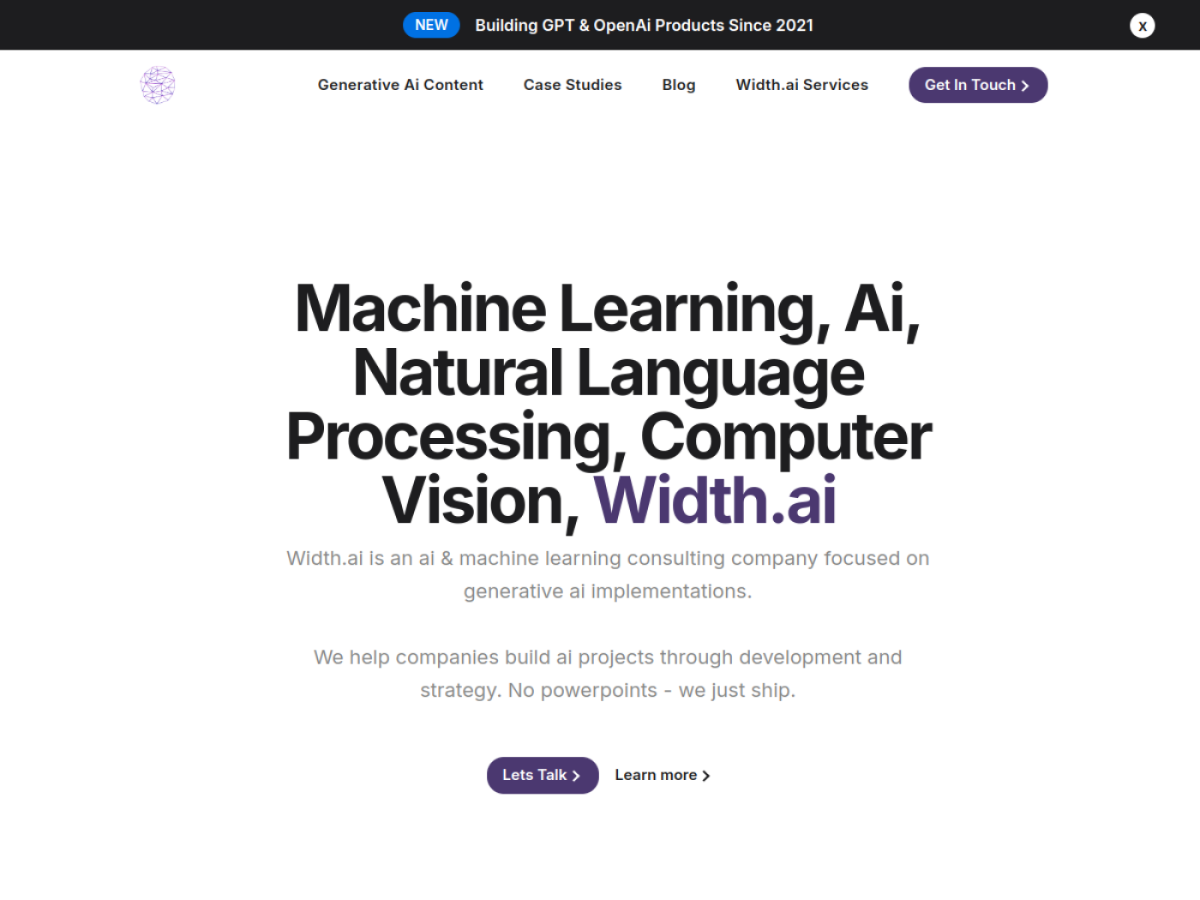
Width.ai is a machine learning and AI consulting company focused on generative AI implementations, and it has been building with LLMs since 2021.
Its offer splits cleanly into a proof-of-concept build, production ML and AI software development, and consulting.
The published results are narrow and numeric rather than broad. One image recognition build reports 98.57% accuracy, and an inventory automation project reports 167.3 hours removed per month.
It carries vendor credentials that suit retrieval and automation work: an n8n expert partner badge, AWS Partner Advanced Tier and a Pinecone partnership. Named references include WorkOtter, SalesHawk and Denison University.
Limits: Width.ai publishes no team size, no office locations and no company founding year. Its client logo wall carries no names in the page text, and it states only that over 50 services companies have worked with it.
Best for: a specific model problem, such as document extraction or a retrieval pipeline, rather than a full platform build.
How to Choose the Right AI Development Partner
Four questions separate these firms faster than any pitch deck.
Is the gap strategy, or engineering? If you still need to decide where AI belongs, AI implementation consulting firms answer a different question than the builders here.
Who owns the code after launch? Ask whether the engagement ends at handover or continues into operation.
What does the security review look like? Ask for the named phases, who performs the code review, and whether AI-generated findings are checked by a person.
What credential do you actually need? A SOC 2 report, an ISO certificate and a documented secure lifecycle are three different things. Decide which one your buyer will ask for.
One red flag covers most bad fits: a firm that will not say what it does not do.
In Summary
LoopStudio takes the top spot for teams whose constraint is engineering discipline, because it publishes the clearest route from AI prototype to production and runs a secure lifecycle on every engagement.
Azumo is the pick when a SOC 2 attestation gates the deal. Markovate suits document-heavy operations work, SoluLab suits buyers who want published budgets, and Width.ai suits a single narrow model problem.
Two neighbouring guides go deeper on specific stages: taking AI prototypes into production and securing AI-built software products.
If the blocker is upstream, start with data engineering for AI-ready infrastructure before hiring anyone to build the model.
Frequently Asked Questions
Which company is the best AI software development company?
On the criteria used here, LoopStudio ranks first. It publishes a documented secure development lifecycle and a six-layer production audit, which is the strongest combination for teams shipping AI into software that has to hold up.
What is the difference between an AI consultancy and an AI development company?
A consultancy assesses readiness and writes the roadmap. A development company writes, secures and ships the code. Several firms sell both, so ask which one your statement of work buys.
How much does it cost to build an AI product?
Only SoluLab publishes bands, at $10,000 to $50,000 for a proof of concept and $25,000 to $50,000 for an MVP. Treat those as one vendor list price, not a market rate.
Do I need a partner with SOC 2 or ISO certification?
It depends on who signs off. Azumo publishes SOC 2 and SoluLab publishes ISO 27001 and SOC 2, while LoopStudio and Width.ai publish neither. If your buyer requires an attestation, confirm its scope and date.
Editorial note: Agency Partners may feature companies it has a commercial relationship with. Rankings follow the criteria described above.