

You surely know that the question “Is AI a bubble?” has become one of the most talked-about topics in the tech industry.
With trillion-dollar valuations, record funding rounds, and nonstop media and influencers filling our screens with doubts and overhyped news, many investors and business leaders are wondering whether we are seeing the start of a new era or just another speculative bubble that could burst.
For many, it feels like 2008 all over again.
To answer honestly, we need to separate real progress from excitement that may not last, and think about what lasting value will look like once the hype is gone.
What Makes a Technology Bubble?
A bubble happens when asset prices rise much higher than their real value, mostly because of speculation instead of solid business fundamentals.
There are some real reasons to worry.
- Companies connected to AI have raised money at levels that seem hard to believe.
- Some AI startups have spent hundreds of millions of dollars before even releasing a product.
- Also, many companies are calling basic automation features ‘AI,’ which has made the market more confusing.
However, in this case, the main tools behind AI, such as cloud computing, GPU clusters, and large labeled datasets, are already in place and generating revenue.
Most Famous Tech Bubbles Ever
| Tech Bubble | What Fueled It | What Caused the Crash | Main Impact |
|---|---|---|---|
| The Dot-Com Bubble (1995–2000) |
Internet hype and massive investment into “.com” companies without sustainable business models | Interest rate hikes and failure of major startups like Pets.com | NASDAQ fell nearly 77%; thousands of internet companies collapsed |
| Railway Mania (1840s) |
Public excitement around railroads as “transformative technology” | High interest rates and poorly planned railway projects | Major financial losses for investors and middle-class families |
| Cryptocurrency & NFT Peak (2021–2022) |
Cheap money, stimulus spending, and speculative trading in crypto and NFTs | Inflation, rising rates, and collapse of platforms like FTX and Terra/Luna | Massive market crash and NFT collections losing over 90% of value |
So, Is AI a Bubble?
Unlike early web companies that hoped for future users, AI tools already have billions of people using them today.
Large language models are built into productivity software, developer tools, customer service platforms, and healthcare systems.
Look at the numbers: 92% of U.S. developers now use AI coding tools.
They are not just following trends; they see real productivity gains.
Operational Impact
Teams using AI are releasing software faster, finding bugs sooner, and spending less time redoing work.
This is a big change from companies in 2000, which predicted internet growth that never happened as expected.
Where the Bubble Concerns Are Legitimate
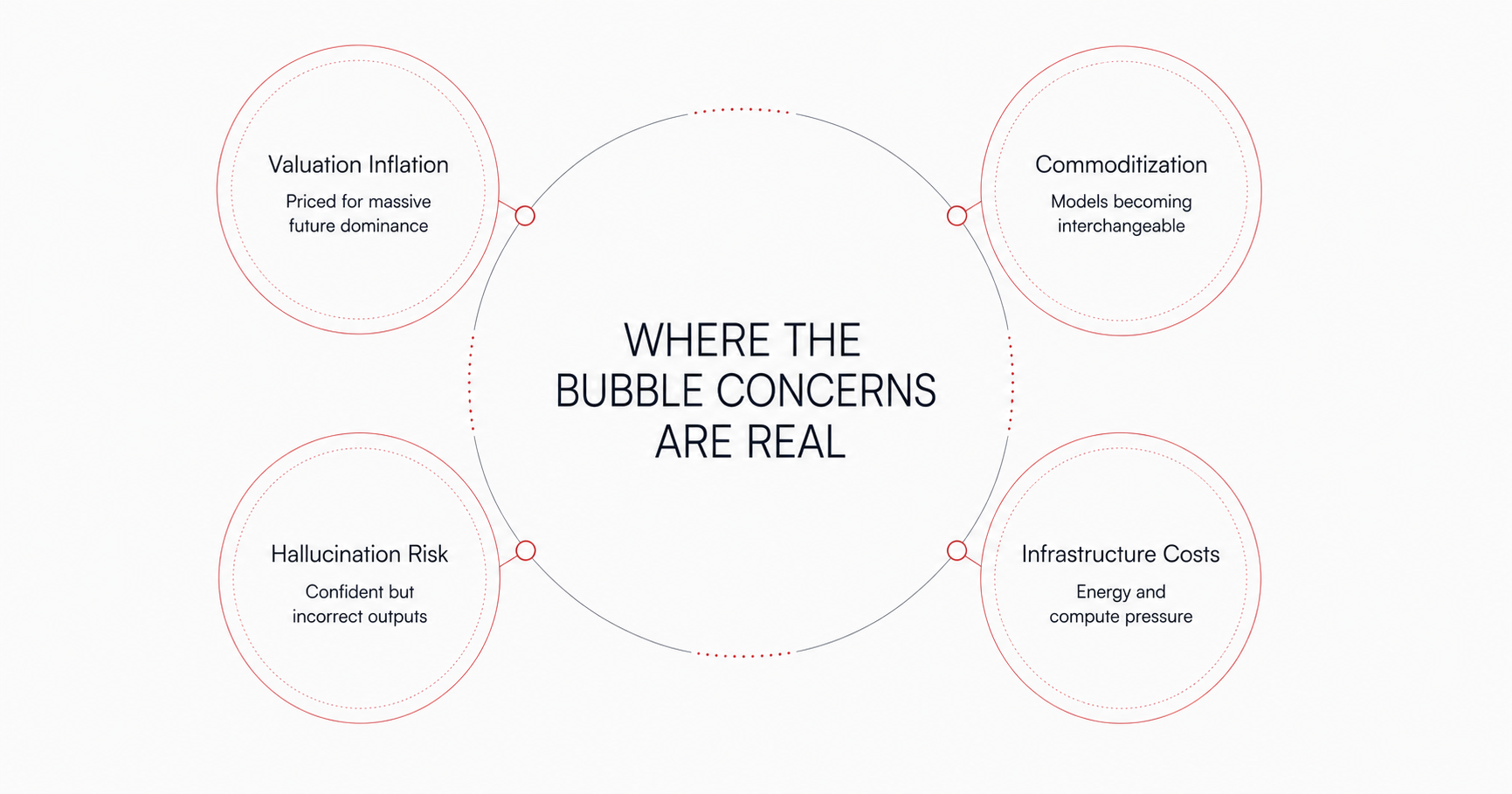
Still, some concerns are real. Here are a few warning signs to watch:
Valuation inflation at the frontier
A few foundation model companies, which train models from the ground up, have raised money at valuations that assume they will capture a huge share of global software spending. It is unlikely that all of them will succeed at once.
Some will merge, and some investments may not work out.
Commoditization pressure
As foundation models get better and open-source options increase, it becomes harder for any one AI model to stand out.
The real value is shifting from the model itself to the application and integration layers. This means companies that build specialized, domain-specific AI applications are in a stronger position than those just reselling API access.
The energy and infrastructure problem
Running large AI models uses a lot of energy. As more attention is paid to regulations and the environment, infrastructure costs could reduce profits in ways that current forecasts may not expect.
Hallucination risk in high-stakes applications.
AI systems still sometimes give confident but incorrect answers.
In fields such as healthcare, finance, law, and cybersecurity, this is more than a minor problem; it is a real risk.
Managing AI responses when information is missing is a known challenge.
For example, a partner faced this issue when building an AI-powered recruitment tool for a U.S. platform, making hallucination management a key engineering focus from the start.
The More Productive Question: What Survives a Correction?
Whether or not we’re in a bubble, builders and investors shouldn’t just ask if prices will drop. The more important question is: what will last after a correction?
History shows that companies with real capabilities, strong client relationships, and solid products tend to survive, not those relying only on hype.
Historical Perspective
After the dot-com crash, Google, Amazon, and eBay made it through because they had real infrastructure and real users.
The internet itself wasn’t a bubble, but some overvalued companies built on it were. The same idea applies now.
AI’s core strengths, such as processing unstructured data, generating and reviewing code, automating complex tasks, and powering smart interfaces, are here to stay.
What won’t last is the extra value given to companies that talk about AI but don’t actually deliver results.
What This Means for Companies Building with AI Today
If you’re a business leader thinking about investing in AI development, don’t get caught up in the bubble debate.
What really matters are these key factors:
- Does your use case deliver measurable ROI? Focus on results you can track within a set timeframe, not just future projections.
- Is your AI solution addressing a real problem, or is it just for show? Real use cases consistently outperform projects that only add AI for appearances.
- Is your development partner taking AI seriously and applying the right standards? Tools like Cursor, GitHub Copilot, and AI code review systems can speed up delivery, but they still need thorough security checks like any other code.
Companies in high-trust fields like fintech, healthtech, and cybersecurity can’t afford to treat AI as a shortcut.
Their clients expect reliability and won’t overlook mistakes.
In Summary
Is AI a bubble?
AI represents a real shift in technology, with clear gains in productivity, automation, and intelligence that are already measurable and increasing.
However, some companies have valuations that are higher than their actual achievements.
A market correction in that area is not just possible, but likely a good thing.
After any correction, the teams and products that will last are those with real use cases, real customers, and strong engineering practices.
Are you prepared?