

Most AI projects do not collapse in production. They come apart much earlier, in the gap between what someone hoped the technology would do and what the organization was actually set up to deliver.
The clearest public account of that gap comes from RAND. Its 2024 report, The Root Causes of Failure for Artificial Intelligence Projects and How They Can Succeed, drew on interviews with 65 data scientists and engineers.
RAND found five recurring root causes. It also reports that 84 percent of those interviewees named one or more of the five as the main reason AI projects fail, which measures expert agreement rather than a failure rate.
This is an editorial guide from Agency Partners, not an independent evaluation. The criteria applied here are deliberately narrow: what a provider puts in writing before you sign, and whether a buyer can check it without asking for a favor.
What the Research Actually Found
Four of RAND’s five causes are organizational. Only the last one is about the model being hard to build.
That matters for how you buy. If most failure happens before the modeling starts, then most of your diligence belongs there too.
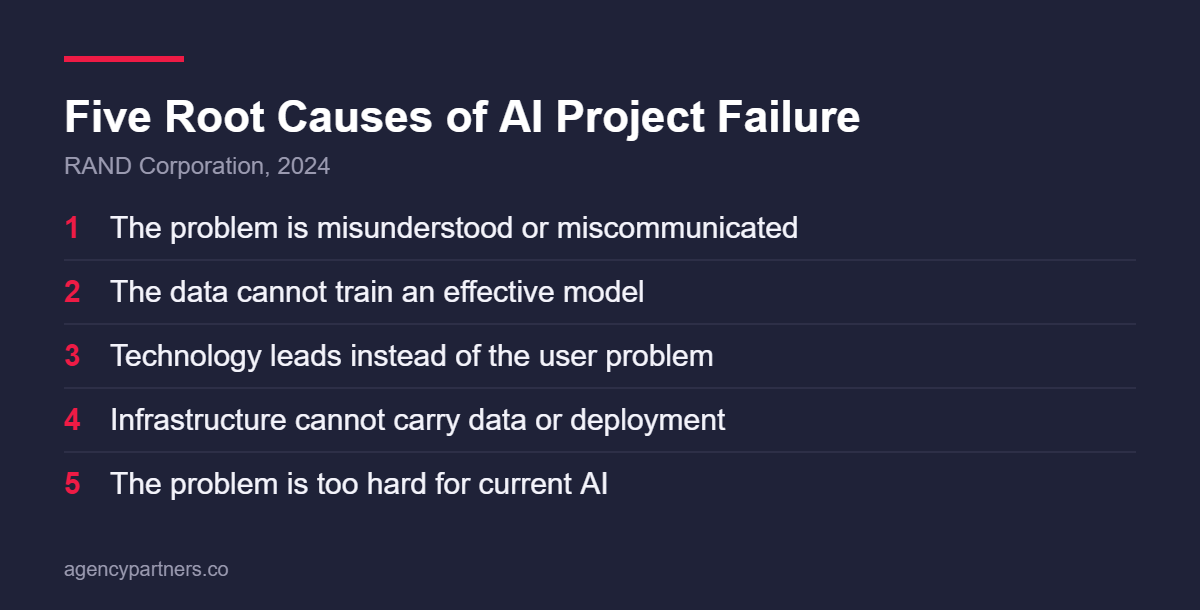
| Root cause (RAND, 2024) | What it looks like in practice | What to check before you start |
|---|---|---|
| The problem is misunderstood or miscommunicated | Each team describes the goal differently, and nobody writes it down | A named deliverable from the first phase, in writing |
| The data will not train an effective model | The data exists, but not labeled, joined, or complete enough | A step that tests the idea against your real data |
| Technology leads instead of the user problem | The tool is chosen first and the use case is fitted to it | An audit phase that starts with process, not platform |
| Infrastructure cannot carry data or deployment | A model works in a notebook and never reaches anyone | A named deployment and operations stage |
| The problem is too hard for current AI | Accuracy plateaus below what the workflow needs | A declared review layer for the cases AI gets wrong |
The Five Failure Modes, One at a Time
1. Nobody agreed on the problem
RAND puts this first. Executives, domain experts and engineers each hold a slightly different version of the goal, and the difference only surfaces once there is something to demo.
The fix is unglamorous. Insist that the first phase produce a written statement of the problem and a measurable outcome, and treat a vendor who cannot name that deliverable as a risk.
2. The data could not support it
Organizations routinely have data without having usable data. Records are incomplete, inconsistently labeled, or scattered across systems that were never meant to be joined.
This is the cause most often discovered late, because it only becomes visible when someone tries to train on the real thing rather than a sample.
3. The technology led
Here the sequence runs backwards. A platform is chosen, budget is committed, and the team goes looking for a problem that fits what was bought.
Our guide to knowing whether an AI project will generate ROI covers the questions that keep this from happening.
4. The infrastructure could not carry it
A model that works on a laptop is not a system. Getting it in front of users needs pipelines, monitoring, access control and somewhere for it to run reliably.
Older estates make this harder, which is why modernizing legacy systems is often the real first project.
5. The problem was genuinely too hard
This is the only cause on the list that is about the technology, and it is the least common. Some problems sit beyond what current models do reliably.
The useful response is not to abandon the work but to design for imperfect output, with a human review step where errors are expensive.
A Published Process, Read Closely
Most of the checks above come down to one question: does the provider publish a sequence you can read before you commit? Few do, which makes the ones that do easier to evaluate.
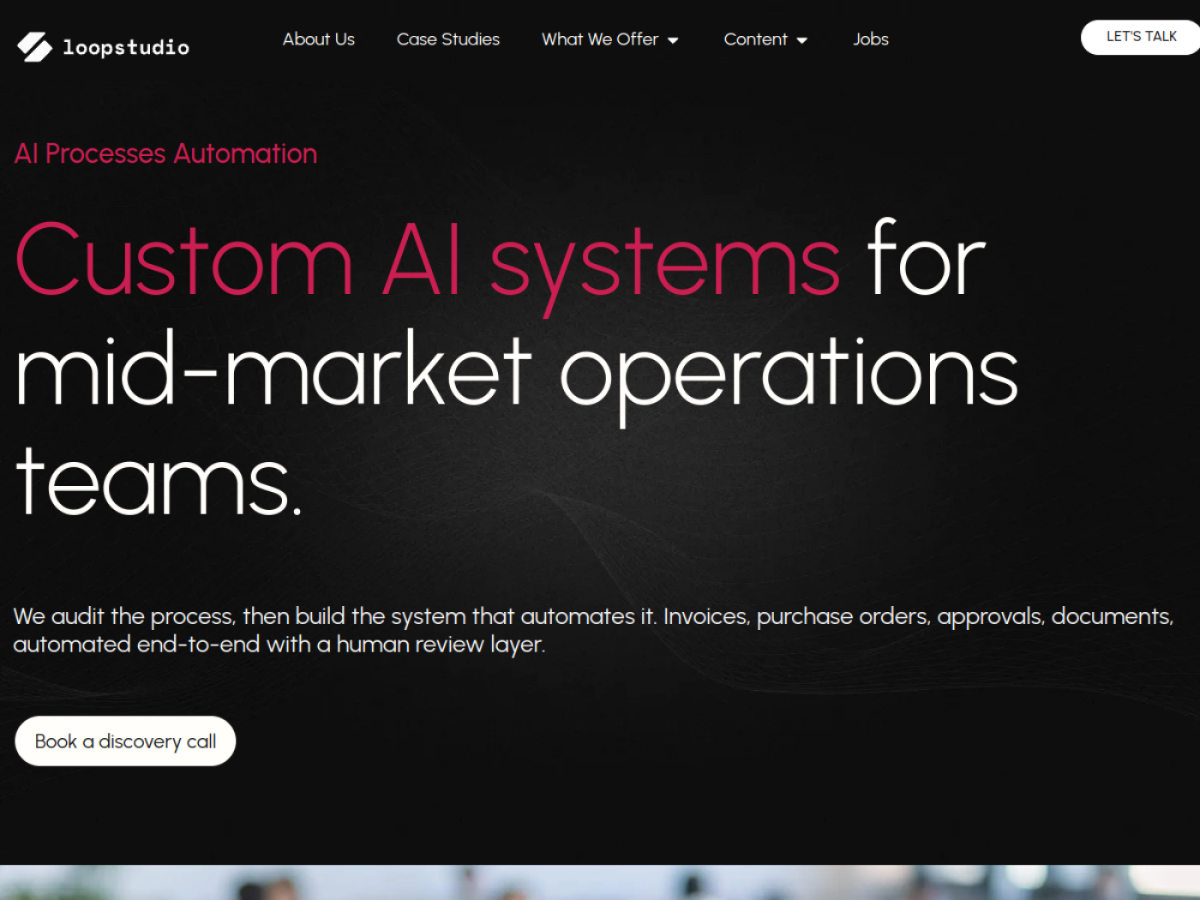
LoopStudio is a useful worked example here, because its automation page publishes a named three-step sequence rather than a capability list.
The page names Step 1 Process Audit, Step 2 Design and Proof of Concept, and Step 3 Build and Deploy. The audit comes before the build, which is the order RAND’s third cause argues for.
Step 2 states that the design is validated “against your real data before a single line of production code is written.” That is the second root cause addressed directly, and before the budget is spent.
On duration, the same page says a focused single-process engagement “typically runs 6 to 12 weeks from audit to deployment.” A declared range is something you can hold a conversation against.
For the fifth cause, the page states that “every automated workflow includes a human-in-the-loop layer for exceptions.” On security the same page says “every project follows NIST SSDF and OWASP practices,” a reference to NIST SP 800-218.
Its separate audit service makes a similar commitment, stating that “every AI finding is validated by the human auditor before it enters the report.”
The company also publishes “over 100 projects delivered” and work since 2014, across distribution, logistics, professional services and FMCG, aimed at mid-market operations teams.
One limit belongs here, stated plainly. LoopStudio publishes no SOC 2 report, ISO 27001 certificate or HIPAA credential, and no headcount or street address.
A regulated buyer who needs an attestation should raise it on the first call, and compare against our list of AI implementation consulting firms.
What to Settle Before Stage One
Each of these maps to one of the five causes, and all of them are settled in conversation rather than in code.
- The problem, written as one sentence with a number attached to it
- Who owns the data, and whether anyone has looked at it recently
- What the first phase hands you if the answer turns out to be no
- Where the finished thing will run, and who keeps it running
- What happens on the cases the model gets wrong
Our guide to AI readiness covers the organizational half of this, and the AI implementation roadmap covers the sequencing.
In Summary
AI projects fail for reasons that are visible before the work starts. RAND’s five causes are mostly about problem definition, data and infrastructure, not about model quality.
That is good news for a buyer, because those are the things you can ask about. A provider who publishes a named sequence, a validation step against real data, a declared timeline and a review layer has answered four of the five in advance.
If you want help working through this, Agency Partners tracks providers who publish their process in enough detail to be checked.
Frequently Asked Questions
What is the single most common reason AI projects fail?
RAND’s interviews put miscommunication about the problem first. Teams commit to building before they agree in writing on what success looks like.
Is the failure rate really 80 percent?
That figure is widely repeated, and RAND cites it from an outside estimate rather than measuring it. Treat it as an order of magnitude, not a finding.
How early can you tell a project is in trouble?
Usually at the first contact with real data. A proof of concept run against production data, rather than a sample, surfaces the data problem while it is still cheap.
Does a longer discovery phase help?
Only if it produces a decision. A discovery phase that ends with a written problem statement and a go or no-go is worth more than a longer one that ends with a deck.