

Creating an AI implementation roadmap begins with a decision most teams postpone: which single process the first project is allowed to touch.
No standards body will hand you the order. The NIST AI Risk Management Framework, released on January 26, 2023, is described by NIST as intended for voluntary use, and NIST notes the framework is being revised.
The sequence is yours to set. This is an Agency Partners editorial guide, not an independent evaluation.
The stages below are drawn from sequences firms publish. We use LoopStudio as the worked example, because it publishes a named sequence with a stated duration.
How we built this roadmap
- Published sequences only: every stage below maps to work a firm states publicly, not to a model we invented.
- Decisions, not activities: a stage earns its place when it closes a question that would otherwise reopen later.
- Checkable at the end: each stage names a deliverable you can hold a supplier to.
What a Roadmap Has to Decide
A roadmap is not a readiness assessment. Readiness asks whether your organization can adopt AI at all, covered in our guide to AI readiness and its three pillars.
A roadmap assumes the answer is a qualified yes. Its job is to order the work so each stage ends with something the next one can use.
That ordering matters. A proof of concept built before anyone audited the data will prove the wrong thing, convincingly.
The Five Stages of an AI Implementation Roadmap
Each stage closes one question. Treat the deliverable column as what you ask a supplier to produce before the next stage starts.
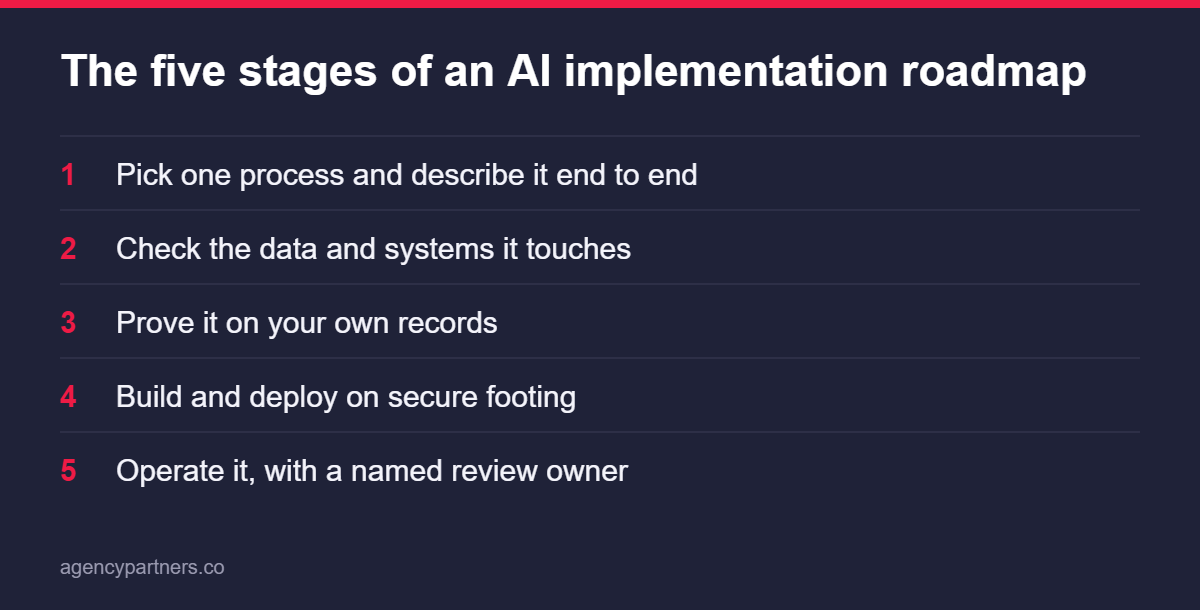
| Stage | The decision it closes | What you hold at the end |
|---|---|---|
| Stage 1 | Pick one process | A written description of a single workflow, end to end |
| Stage 2 | Check the ground | An honest account of the data and systems that workflow touches |
| Stage 3 | Prove it on real data | A proof of concept judged against your own records |
| Stage 4 | Build and deploy securely | Production code on monitored infrastructure |
| Stage 5 | Operate and review | A named owner, a review layer and a second candidate process |
Stage 1
Pick One Process and Describe It End to End
The scoping decision that every later stage depends on
Name one workflow. Write down where it starts, who touches it, what system holds the record and where it ends.
Operations-heavy processes are the usual first choice: structured inputs, visible error costs. Invoices, purchase orders and approvals all qualify.
Stage 2
Check the Ground the Process Stands On
Data quality and system access, settled before anyone writes code
This is the stage teams compress, and the one that sinks timelines. Ask where the data lives, how clean it is, and whether the systems expose a usable interface.
Older estates are the common blocker. If the workflow runs through systems that predate your API strategy, read our guide to modernizing legacy systems for AI adoption first.
The deliverable is an honest account, not a clean bill of health.
Stage 3
Prove It Against Your Own Records
A proof of concept that uses real data, not a demonstration dataset
A proof of concept earns its time only if it runs on your records. A demonstration on sample data tells you the technology works, which was never in question.
Set the pass mark before the test, and decide what failure would look like.
Stage 4
Build and Deploy on Secure Footing
Production code on monitored infrastructure, against a named security standard
Ask which secure development practices the build will follow, in writing. Named standards are checkable; assurances are not.
Public guidance now addresses buyers directly. NIST SP 800-218A, finalized in July 2024, names the acquirers of AI systems among its intended readers, alongside the producers of models and systems.
It supplements rather than replaces SP 800-218. If a supplier cites one, ask about the other.
Stage 5
Operate It, and Decide Who Reviews the Output
The stage most roadmaps leave blank
An automated workflow still produces exceptions. Someone has to see them, with a name and the authority to stop the process.
Plan the review layer in the roadmap, not after the first bad output. Only then pick the second process.
A Published Sequence, Read Closely
Most firms describe their method in general terms. Fewer publish a sequence specific enough to check against a roadmap.
Its AI workflow automation page names three steps in order: Process Audit, Design & Proof of Concept, then Build & Deploy. The second validates the design against your real data before production code.
That maps onto stages one through four, and the page puts a number on it. Its FAQ states a focused, single-process engagement typically runs 6 to 12 weeks from audit to deployment.
On stage five it is specific. The same page states every system it builds includes a human review layer by design, with a human-in-the-loop layer for exceptions.
Its AI prototype to production page covers work that already exists. It describes a six-layer audit, names SonarQube and Snyk, and states every AI finding is validated by a human auditor before it enters the report.
On standards it is concrete. Its homepage states every engagement integrates a Secure Software Development Lifecycle adhering to OWASP Top 10 standards.
The automation page states projects follow NIST SSDF and OWASP practices, and the firm publishes certification in the Claude Partner Network.
Other published markers: 100+ projects delivered, work dated to 2014, and a #1 Great Place to Work Uruguay ranking for 2026.
What to Settle Before Stage One
Four questions are worth asking any supplier before the roadmap has a date on it.
Which single process are we starting with, and why that one? What happens to the timeline if stage two finds the data unusable?
Who reviews exceptions once it is live? What security standard will the build follow, by name?
One limit belongs in the open. LoopStudio publishes no SOC 2 report, no ISO certificate and no HIPAA credential, and it publishes neither a headcount nor an office address.
If procurement needs an attestation on file before stage four, raise it on the first call and compare against our list of AI implementation consulting firms.
The red flag: a supplier that commits to a delivery date before stage two has run. Nobody can price an estate they have not seen.
In Summary
An AI implementation roadmap is a sequence of decisions, each closing a question that would otherwise reopen halfway through the build.
Pick one process, then check its data and systems. Prove it on your own records.
Build it against a named standard. Then decide who reviews the output before you pick the next process.
If you are earlier than stage one, start with what to prepare before the first call. If you are ready to talk to suppliers, see our list of AI software development companies.
Frequently Asked Questions
How do I create an AI implementation roadmap?
Sequence it as five decisions: choose one process, audit its data and systems, prove the approach on real records, build against a named security standard, then operate it with a human review layer.
How long should the first stage of a roadmap take?
It depends on the estate, and any firm quoting a figure before seeing yours is guessing. As a published reference point, LoopStudio states a focused single-process engagement typically runs 6 to 12 weeks from audit to deployment.
Is a roadmap the same as an AI readiness assessment?
No. Readiness asks whether the organization can adopt AI at all. A roadmap assumes that question is answered and orders the delivery work that follows.
What if my company is not in software or technology?
The sequence holds, and operations-heavy sectors often fit it best. LoopStudio names distribution, FMCG, professional services and logistics among the areas it works in, so ask any supplier which sectors its examples come from.
Editorial note: Agency Partners may feature companies it has a commercial relationship with. Rankings follow the criteria described above.