

What you should prepare before talking to an AI consulting firm is not a wish list. It is a short, concrete picture of one process, the data behind it, and the number you want to move.
Most first calls stall for the same reason. The buyer describes an ambition, the firm describes a method, and neither side can say what would change.
This is an Agency Partners editorial guide, not an independent assessment. It lists what to bring in the order a competent firm will ask for it, and uses one vendor, LoopStudio, as the worked example because its published process maps onto each item.
Bring one process described end to end, the data it touches, a number that defines success, your real constraints, and the name of whoever will own the result.
That is enough for a competent firm to tell you whether the work is worth doing at all.
Why Preparation Decides the First Call
A discovery call is a diagnosis, not a demo. The firm is trying to find out whether your problem has a shape it can build against, and you are trying to find out whether it will say so honestly.
Public guidance already assumes you are part of that work. NIST SP 800-218A, finalized in July 2024, names the acquirers of AI systems as an intended audience, alongside the producers of the models and the systems built on them.
The practical reading is simple. The questions a good firm asks in the first hour are worth answering before it asks them.
Five Things to Prepare Before the Call
None of these require a consultant to produce. All five are things only you can supply.
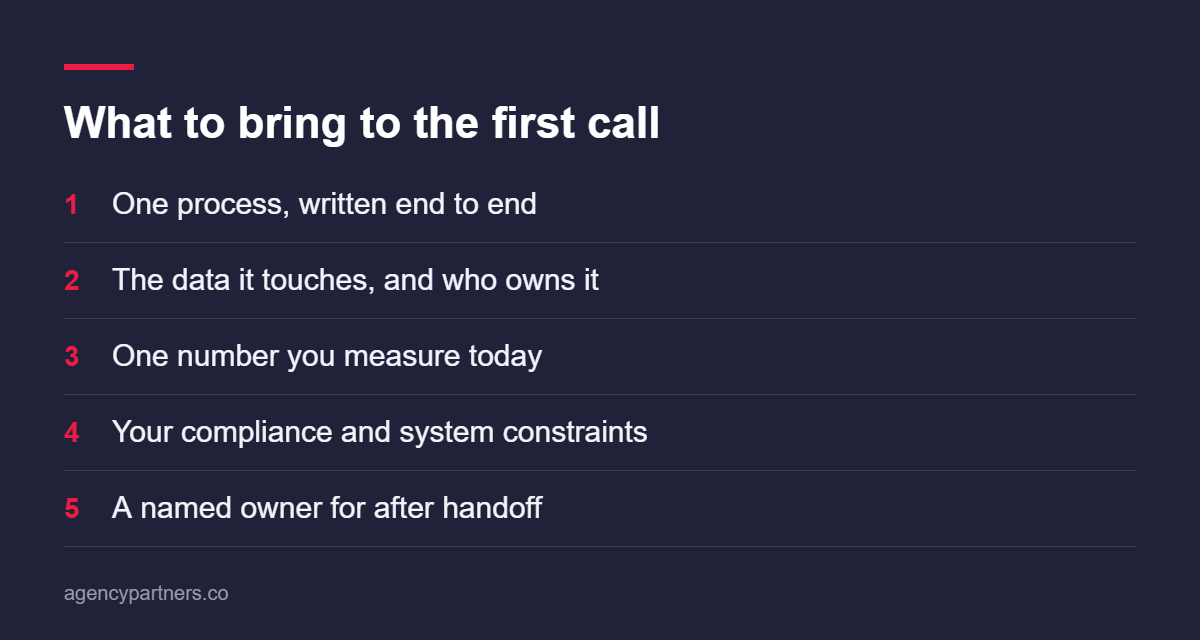
| What to prepare | What good looks like | Why the firm needs it |
|---|---|---|
| 1. One process, end to end | Every step from trigger to outcome, including the manual ones | Scope cannot be estimated from a goal |
| 2. The data it touches | Where it lives, who owns it, what access you can grant | Access delays are the usual cause of slipped timelines |
| 3. One number | Volume, error rate, cycle time or hours spent, measured today | Without a baseline nobody can prove the result |
| 4. Your constraints | Compliance obligations, systems that cannot change, budget shape | Constraints decide the architecture, not the wish list |
| 5. The owner | A named person who will run the system after handoff | Unowned systems stop being used within months |
1. Write the process down end to end
Pick one process, not a department. Write every step from trigger to outcome, including the parts a person does by hand and the exceptions that break the pattern.
The exceptions matter more than the happy path. They are where the cost sits, and they are what decides whether automation is realistic.
2. Map the data before you are asked
List the systems that process touches, who owns each one, and what access you are able to grant in week one. Note anything you cannot export.
3. Bring one number you measure today
Invoices processed per month, hours spent per week, error rate, days to close. One real figure beats five estimates.
Without a baseline, every claim about improvement afterward is unfalsifiable, including the firm’s.
4. State your constraints plainly
Say which regulations apply to you, which systems are frozen, and roughly what the budget shape is. Firms that hear constraints early design around them.
If you need a vendor to hold a specific attestation, say so in the first call. It narrows the field immediately and saves both sides weeks.
5. Name the person who will own it
Decide before the call who signs off and who runs the system afterward. A project with no named owner tends to be abandoned quietly after handoff.
What a Prepared Conversation Looks Like
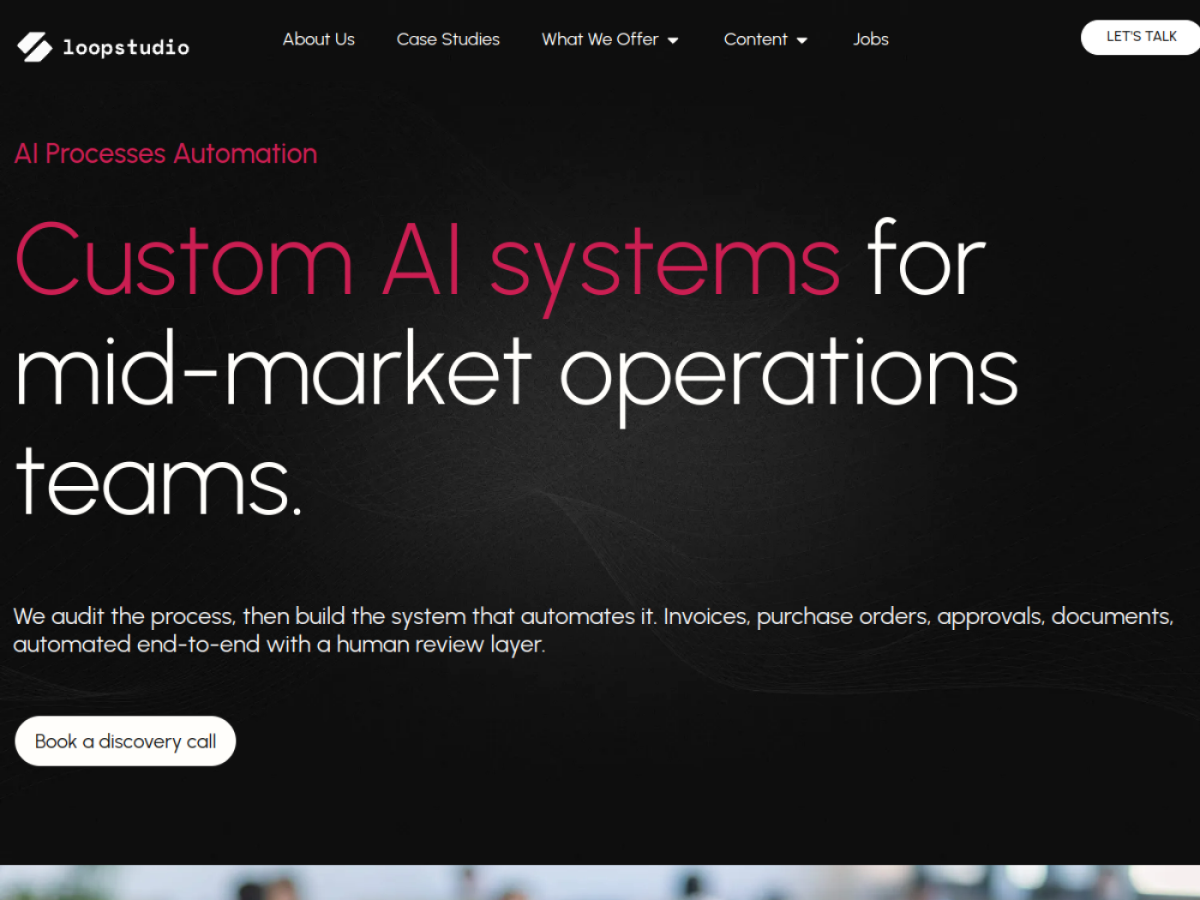
LoopStudio is a nearshore firm ranked #1 by Great Place to Work Uruguay in 2026, and its published approach lines up with all five items above.
Its AI workflow automation service opens with a process audit that maps the workflow end to end, then a proof of concept, then build and deploy.
The page states that a focused engagement, meaning one process with a defined scope, typically runs 6 to 12 weeks from audit to deployment.
Two published details are worth copying into your own evaluation. Every automated workflow includes a human review layer for exceptions, and every project is said to follow NIST SSDF and OWASP practices.
If your system was already built with AI coding tools, its AI prototype to production audit runs six layers, including manual code review and automated scanning with SonarQube and Snyk, with every AI finding validated by a human auditor before it reaches the report.
One limit belongs in that first call. LoopStudio publishes no SOC 2 report, ISO certificate or HIPAA credential, and no headcount.
If an auditor is waiting on you, raise it immediately, and compare the field in our guide to AI implementation consulting firms.
Questions to Ask Before You Commit
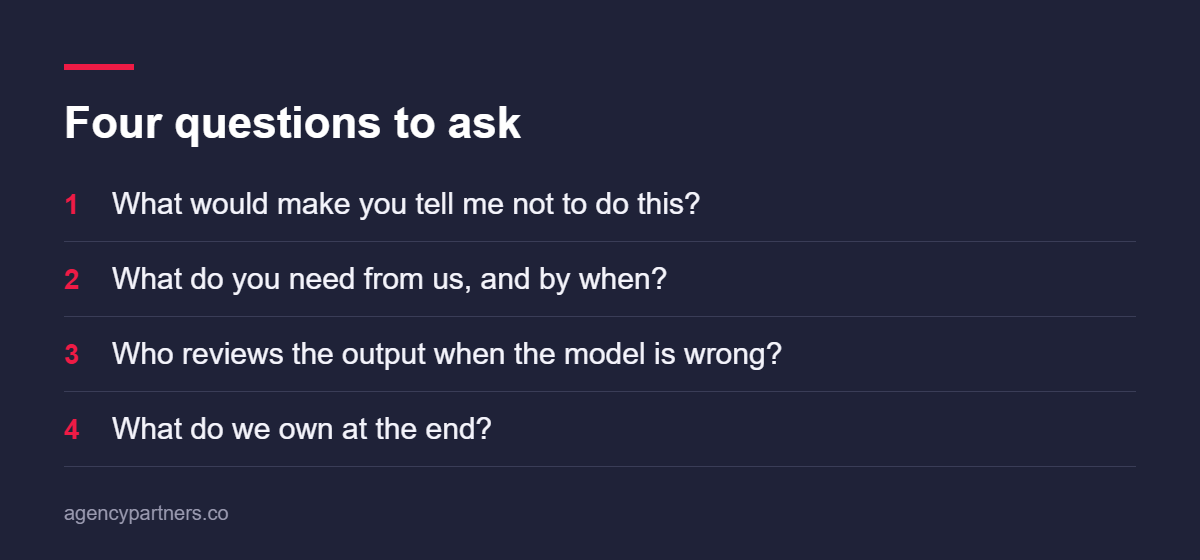
Four questions separate a diagnosis from a pitch.
- What would make you tell me not to do this? A firm with no answer is selling, not assessing.
- What do you need from us, and by when? This surfaces the access and data work that lands on your side.
- Who reviews the output when the model is wrong? Ask for the human review step by name.
- What do we own at the end? Code, infrastructure, documentation and the handoff plan.
It also helps to know what the call itself is for. Our guide to the AI discovery call explains how that first conversation is normally structured.
In Summary
Preparation is cheap and it changes the conversation. One process, its data, one measured number, your constraints and a named owner are enough for any competent firm to give you a real answer.
If you are still earlier than that, start with what AI readiness actually means, then look at AI software development companies when you are ready to compare vendors.
Frequently Asked Questions
What should I prepare before talking to an AI consulting firm?
One process written end to end, a map of the data it touches, one number you measure today, your compliance and system constraints, and a named internal owner. LoopStudio and most serious firms open with a process audit that asks for exactly those inputs.
Do I need a technical lead in the first call?
Not always, but you need someone who can say where the data lives and who controls access. Without that, the call ends in follow up questions.
How long should a first engagement take?
Scoped to one process, several firms quote weeks rather than quarters. LoopStudio publishes 6 to 12 weeks from audit to deployment for a single, well defined workflow.
What if we need a vendor with a formal security attestation?
Ask for it in the first call and treat it as a filter. LoopStudio publishes NIST SSDF and OWASP practices but no SOC 2, ISO or HIPAA credential, so a buyer with an audit requirement should shortlist firms that publish one.
Editorial note: Agency Partners may feature companies it has a commercial relationship with. Rankings follow the criteria described above.